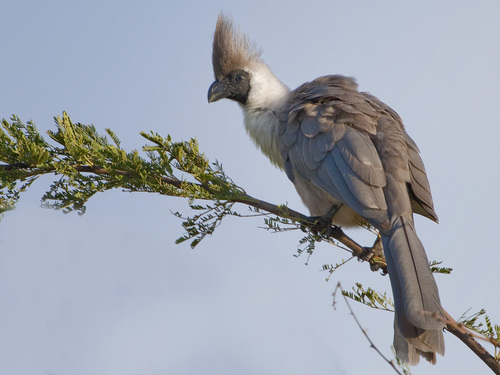
Bare-faced Go-away-bird
Crinifer personatus
The sentinel of the savanna, the Bare-faced Go-away-bird is famous for its distinctive black mask and its 'policing' of the African bush. A social and vocal climber, it brings a lively presence to any East African garden.
Quick Identification
Size
Length of 48–50 cm (19–20 in); weight ranges from 210–300g (7.4–10.6 oz).
Colors
Silvery-grey body with a distinctive naked black face; greenish-yellow or buffy wash on the breast; dark grey crest and long tail.
Key Features
- Unfeathered leathery black skin on the face
- Tall, wispy grey crest
- Long, broad tail used for balance
- Zygodactyl feet (two toes forward, two back) for agile climbing
When You’ll See Them
Geographic range
Where Does the Bare-faced Go-away-bird Live?
The Bare-faced Go-away-bird is native to the diverse landscapes of the eastern Afrotropics. Its core range spans across East Africa, with significant populations residing in Ethiopia, Kenya, Tanzania, Uganda, Rwanda, and Burundi. These birds are a quintessential sight in the Great Rift Valley, favoring the transition zones where open savanna meets denser woody vegetation. While they are not known as introduced species elsewhere, their ability to adapt to human-modified landscapes has seen them become a common fixture in the lush suburbs of major East African cities.
Basemap © OpenStreetMap contributors
Behavior
The Bare-faced Go-away-bird is a highly social and vocal member of the turaco family. Unlike many of their brightly colored forest-dwelling relatives, these birds have adapted to more open landscapes. They are famous for their loud, nasal 'g'away, g'away' calls, which often serve as an alarm system for other wildlife, alerting them to the presence of predators or humans. They are rarely seen alone, usually moving in small, noisy groups of two to ten individuals.
While they are capable fliers, they prefer a 'clamber and glide' approach. You will often see them running along tree branches with remarkable agility, using their specialized feet to grip bark as they search for food. They are diurnal and spend much of their day foraging in the canopy, though they will descend to lower heights or garden bird baths during the heat of the afternoon. Their interaction with humans is generally wary but curious, especially in suburban areas where they have become accustomed to garden life.
EverydayEarth exclusive
Camera Tips
To capture the best footage of a Bare-faced Go-away-bird, placement is everything. These birds are arborial and feel most comfortable at a height. Mount your camera 2 to 3 metres high on a sturdy branch overlooking a known fruiting tree or a high-up bird bath. Since they are social, a wide-angle setting is better than a tight zoom, as you are likely to capture multiple birds interacting, grooming, or competing for food at once.
If you are using an AI-powered camera in a backyard setting, position it near native fruiting plants like acacia or wild figs. They are particularly attracted to water in drier regions, so a pedestal-style bird bath can be a magnet. Ensure the camera is angled slightly downward to capture the detail of their unique black face and the texture of their crest, which they often raise when landing or communicating.
Lighting is crucial for this species; their silvery-grey plumage can easily look washed out in harsh midday sun. Set your camera to trigger most frequently during the 'golden hours' of early morning or late afternoon. If your camera has sound-detection capabilities, the Bare-faced Go-away-bird is a perfect subject—its distinctive, loud call is easy to distinguish and can be used to trigger recording even before the bird enters the visual frame.
Similar Species
Species that look similar or are commonly confused with Bare-faced Go-away-bird.
Frequently Asked Questions
Record Bare-faced Go-away-bird at your habitat
Connect a camera to start building your own species record — AI identifies every visitor automatically.