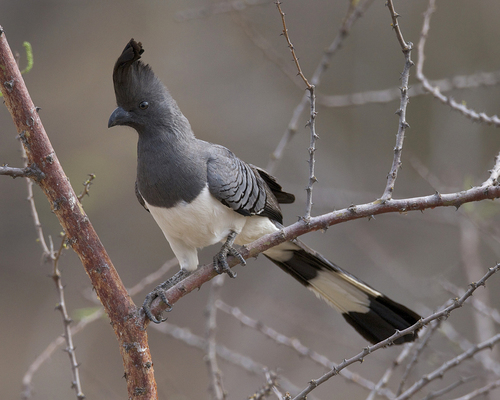
White-bellied Go-away-bird
Crinifer leucogaster
A vocal and charismatic sentinel of the East African savanna, the White-bellied Go-away-bird is famous for its distinctive alarm call and impressive pointed crest. These social birds are a delight for backyard observers, often seen hopping through acacia trees in search of fruit.
Quick Identification
Size
48-51 cm (19-20 inches) in length; weight ranges from 170 to 250 grams (6-9 ounces)
Colors
Ash-grey upperparts and breast; stark white belly and under-wing patches; black and white banded tail; males have black bills while females have pea-green bills
Key Features
- Prominent tall, pointed grey crest
- Bright white belly and under-wing patches visible in flight
- Long, dark tail with distinct white banding
- Gender-dimorphic bill color (black for males, green for females)
When You’ll See Them
Sightings on EverydayEarth
Jul 1, 2026
A White-bellied Go-away-bird rests on a sunlit rocky outcrop, turning its head to observe its surroundings. A smaller, unidentified black bird is briefly seen moving in the background among the rocks.
May 25, 2026
A White-bellied Go-away-bird is perched among the branches of a thorny acacia tree. It remains mostly stationary but actively looks around, turning its head to scan the environment.
Geographic range
Where Does the White-bellied Go-away-bird Live?
The White-bellied Go-away-bird is a quintessential resident of East Africa's arid landscapes. Its core range stretches from central Ethiopia and Somalia through the heart of Kenya and into northeastern Tanzania, with populations also reaching into parts of Uganda and South Sudan. These birds are highly adapted to the "dry country" and are rarely found outside of the Horn of Africa and the East African Rift regions.
Basemap © OpenStreetMap contributors
Behavior
Named for their distinctive, nasal alarm call that sounds remarkably like a human shouting "go-away," these birds are the sentinels of the African savanna. They are highly social and are typically seen in pairs or small family groups, hopping agilely through the branches of acacia trees rather than flying long distances. Their flight is somewhat labored, characterized by a series of heavy flaps followed by a glide.
In the wild, they are known for their "turaco-creep"—a unique way of running along branches using their semi-zygodactylous feet, where the fourth toe can rotate forward or backward to grip. While they can be wary of humans in remote areas, they often become quite accustomed to people in garden or lodge settings where fruit is available, often announcing their presence with loud, squawking "waa-waa" calls.
EverydayEarth exclusive
Camera Tips
To capture the White-bellied Go-away-bird on camera, focus on their love for water and fruit. Placing an AI-powered camera near a birdbath or a consistent water source in an arid garden is the most effective strategy. These birds are frequent drinkers and will visit water holes daily. Position the camera at a slight downward angle, approximately 3 to 5 feet off the ground, overlooking the water's edge to capture the full detail of their impressive crest and white underbelly.
For those looking to use bait, these birds are highly attracted to halved papayas, mangoes, or even bananas placed on an elevated platform feeder. Since they are "creepers" rather than high-flyers, mount your camera on a sturdy branch or a wooden post near the fruit. Ensure the camera has a fast trigger speed, as they often hop quickly between branches rather than landing and staying still for long periods.
The best lighting occurs in the early morning or late afternoon when their grey plumage won't be washed out by the harsh equatorial sun. Setting your camera to take short video bursts (10-15 seconds) is better than still photos alone, as it allows you to capture their unique hopping movement and hear their famous vocalizations. During the breeding season, keep an eye out for pairs interacting, as their social displays are visually striking.
Similar Species
Species that look similar or are commonly confused with White-bellied Go-away-bird.
Frequently Asked Questions
Record White-bellied Go-away-bird at your habitat
Connect a camera to start building your own species record — AI identifies every visitor automatically.