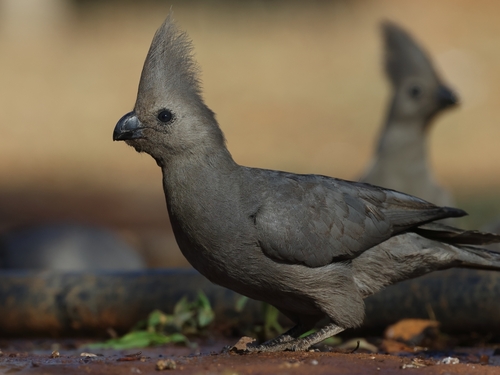
Grey Go-away-bird
Crinifer concolor
With its distinctive shaggy crest and its famous 'go-away' warning call, the Grey Go-away-bird is the charismatic sentinel of the African bush. A bold and social member of the turaco family, this 'Grey Lourie' is a favorite for backyard birders across Southern Africa.
Quick Identification
Size
Length of 47–51 cm (18.5–20 in); weight ranges from 200–300 g (7–10.5 oz)
Colors
Uniform smoke-grey plumage with a slightly darker face; black bill and feet; crest is a matching grey
Key Features
- Distinctive tall, shaggy grey crest
- Long, tapered tail
- Loud, nasal 'kweh' or 'go-way' call
- Uniform grey body without bright colors
When You’ll See Them
Sightings on EverydayEarth
Jul 27, 2026
A Grey Go-away-bird is perched on a branch at the edge of the watering hole. It remains still for several seconds, observing its surroundings, before taking flight and exiting the frame to the left.
Jul 13, 2026
A Grey Go-away-bird is perched at the left edge of the watering hole. It remains relatively still, likely observing its surroundings or preparing to drink, while its reflection is visible in the calm water.
Jul 13, 2026
A Grey Go-away-bird is perched on a stump near the water's edge. It remains mostly stationary but is heard and seen emitting its loud, distinctive 'kwa-kway' alarm call several times while looking around the woodland environment.
Jul 12, 2026
A Grey Go-away-bird is perched on a bare branch to the left of the watering hole. It remains stationary, observing the pan in the clear morning light.
Jul 11, 2026
A Grey Go-away-bird is perched on a small stump at the edge of the watering hole. It remains stationary, looking around the landscape, before taking flight and heading into the background trees.
Jul 7, 2026
A Grey Go-away-bird is perched on a dry branch overlooking the water hole. After a brief moment of scanning the environment, it takes flight and moves out of view to the left.
Geographic range
Where Does the Grey Go-away-bird Live?
This charismatic bird is a native of the southern Afrotropical region. Its core range spans across Southern Africa, encompassing most of Namibia, Botswana, Zimbabwe, and northern South Africa, as well as parts of Mozambique, Zambia, and southern Angola. They are highly adaptable and thrive in both arid thornbush country and lush suburban environments within these regions, provided there is sufficient fruiting vegetation and water.
Basemap © OpenStreetMap contributors
Behavior
The Grey Go-away-bird is famous for its bold personality and its role as a 'sentinel' of the African bush. They are highly social, often seen in small family groups or parties of up to 20 individuals. Rather than being strong flyers, they are agile climbers, using their zygodactyl feet (two toes forward, two back) to scramble through thorny acacia branches with impressive speed. They are well-known for their habit of alerting all nearby wildlife to the presence of predators or humans with their unmistakable rasping call.
In suburban settings, they become quite habituated to humans, frequently visiting garden birdbaths and fruiting trees. They are fond of sunbathing and dust bathing, often found on the ground in dry, sandy patches. Their social interactions involve much mutual preening and vocalization, making them one of the most animated and entertaining species to observe in a backyard or park environment.
EverydayEarth exclusive
Camera Tips
To capture the Grey Go-away-bird on camera, focus on their two favorite resources: water and fruit. Placing an AI-powered camera near a raised birdbath or a shallow water feature is the most effective strategy. These birds are regular drinkers and love to splash around, especially during the hotter midday hours. Set your camera at a height of 4 to 5 feet, angled slightly downward toward the water source to capture their impressive crest and long tail as they land.
If you have fruiting trees like figs, wild olives, or even garden species like guavas and mulberries, mount your camera on a nearby branch. Since they are agile climbers, they often freeze or move slowly while feeding, allowing for high-quality, blur-free images. Use a fast shutter speed or a burst mode if your camera supports it, as their crest-raising displays are sudden and make for spectacular photos. Because they are social, a wider field of view is often better than a tight zoom, as you might catch three or four birds interacting at once.
In terms of timing, while they are active throughout the day, the best light and activity levels usually occur in the early morning and late afternoon. During the heat of the day, they are more likely to visit water for a drink or a dust bath. If you are using a trail camera in a more wild setting, look for 'sentinel' branches—dead, high-visibility perches where they sit to scan for danger and call out. Positioning a camera to view these high points will capture their classic alert posture.
Similar Species
Species that look similar or are commonly confused with Grey Go-away-bird.
White-bellied Go-away-bird
Found further north in East Africa, it has a white belly and a more complex wing pattern compared to the uniform grey of the Crinifer concolor.
Bare-faced Go-away-bird
Identified by its black, featherless face and different call, usually found in more specific East African habitats.
Frequently Asked Questions
Record Grey Go-away-bird at your habitat
Connect a camera to start building your own species record — AI identifies every visitor automatically.