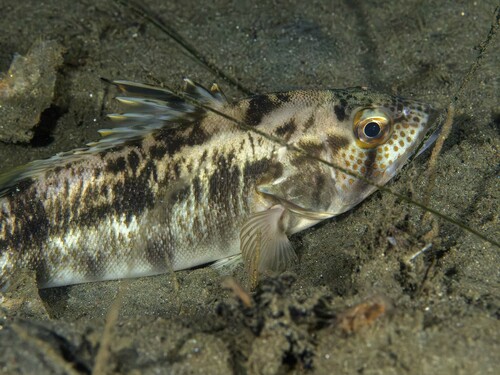
Barred Sand Bass
Paralabrax nebulifer
The ultimate master of camouflage on the Pacific seafloor, the Barred Sand Bass is a prized sight for coastal observers and underwater photographers alike.
Quick Identification
Size
Typically 12–18 inches (30–45 cm), with trophy specimens reaching 26 inches (66 cm) and weighing up to 13 lbs (6 kg).
Colors
Mottled gray, greenish-brown, or tan back with a white underbelly; notable for 7-8 dark, vertical bars along the flanks.
Key Features
- 7-8 dark vertical bars on the sides
- Third dorsal spine is significantly longer than the others
- Large mouth with a protruding lower jaw
- Small golden-brown spots on the snout and cheeks
When You’ll See Them
Geographic range
Where Does the Barred Sand Bass Live?
The Barred Sand Bass is native to the temperate coastal waters of the Eastern Pacific Ocean. Its primary range spans from the central California coast near Santa Cruz down to the southern tip of the Baja California peninsula in Mexico. While they are most abundant in the Southern California Bight, their population is stable across the near-shore shelf, where they rarely venture into water deeper than 200 feet except during specific seasonal migrations.
Basemap © OpenStreetMap contributors
Behavior
The Barred Sand Bass is a master of the 'sit-and-wait' predatory style. Unlike many of its relatives that cruise the mid-water column, this species is primarily benthic, meaning it spends most of its time on or near the seafloor. It utilizes its mottled coloration to blend perfectly into sandy patches, eelgrass, or rocky debris, remaining nearly motionless until prey ventures within striking distance. When it moves, it does so with surprising bursts of speed, propelled by its powerful caudal fin.
These fish are generally solitary for most of the year but become highly social during the summer months. From June through August, they migrate to deeper sandy flats to form large spawning aggregations that can include thousands of individuals. While they are naturally cautious, they are also quite curious; they have been known to approach underwater cameras to investigate sediment clouds or the hum of electronic equipment, often mistaking the disturbance for the activity of smaller prey.
EverydayEarth exclusive
Camera Tips
To capture the Barred Sand Bass on an underwater camera, placement is everything. These fish are bottom-dwellers, so your camera should be mounted within 12 to 24 inches of the seafloor. Look for 'transitional zones'—areas where a rocky reef or kelp forest meets a sandy plain. Sand bass love to sit right on the edge of these structures to ambush prey moving between habitats.
Since they are most active during the day, ensure your camera is positioned to take advantage of natural light filtering through the water column. If you are recording in deeper water (over 30 feet), you may need an external light source, but be careful with high-intensity LEDs, as they can bleach out the fish's silver-gray scales. A wide-angle lens is preferred to capture the 'strike' behavior when they dart out from the sand.
If your local regulations allow, you can attract Barred Sand Bass by lightly disturbing the sand near the camera lens. The sight of a small dust cloud often mimics the behavior of a digging crab or a fleeing flatfish, which will bring curious bass into the frame. Avoid using heavy bait that might attract sharks or large rays that could displace your equipment; instead, focus on areas with natural 'structure' like sunken logs or pier pilings where these fish naturally congregate.
Similar Species
Species that look similar or are commonly confused with Barred Sand Bass.
Frequently Asked Questions
Record Barred Sand Bass at your habitat
Connect a camera to start building your own species record — AI identifies every visitor automatically.