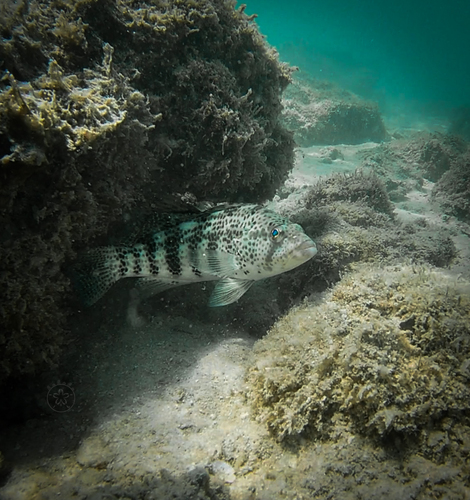
Spotted Sand Bass
Paralabrax maculatofasciatus
The undisputed king of the coastal bay, the Spotted Sand Bass is a master of camouflage and a favorite for underwater observers. With its intricate leopard-like markings and spunky attitude, it's a charismatic addition to any backyard marine camera setup.
Quick Identification
Size
Typically 12–15 inches (30–38 cm), but can reach up to 22 inches (56 cm) and weigh up to 6 lbs (2.7 kg).
Colors
Tan to olive-green body covered in dense, small dark brown or black spots. The spots extend onto the fins, distinguishing them from relatives. The belly is usually creamy white.
Key Features
- Heavy dark spotting across the entire body and all fins
- Third dorsal spine is significantly longer than the others
- Stout, bass-like body shape with a large mouth
- Caudal fin (tail) is slightly rounded or squared off
When You’ll See Them
Behavior
The Spotted Sand Bass, affectionately known as the 'Spotty' by coastal residents, is a highly territorial and hardy predator. Unlike many other sea bass species that prefer the open ocean or deep kelp forests, the Spotted Sand Bass is a specialist of the shallows. They are most at home in the protected waters of bays, harbors, and estuaries, where they claim specific patches of eelgrass or rocky crevices as their personal hunting grounds.
These fish are ambush specialists. They spend much of their day hovering motionless just above the seafloor or tucked into the shadows of pier pilings, waiting for an unsuspecting crab or small fish to drift by. They are known for their 'bold' personality; they are often curious about divers and underwater cameras, sometimes approaching the lens to investigate their own reflection or see if the equipment has stirred up any food from the silt.
EverydayEarth exclusive
Camera Tips
To successfully capture Spotted Sand Bass on a trail camera, you will need a waterproof housing or a dedicated underwater action camera. The most productive placement is at the edge of an eelgrass bed or near the base of a dock piling. These fish are 'structure-oriented,' meaning they rarely swim in open, sandy water without a nearby hiding spot. Aim your camera at a 45-degree downward angle toward a patch of mixed sand and vegetation at a depth of 3 to 10 feet.
Timing is everything with this species. Rather than focusing on the time of day alone, consult a local tide chart. 'Spotties' are most active when the tide is moving—either coming in or going out. This movement flushes prey out of the grass and rocks. Position your camera so the lens is facing away from the sun (usually North or South) to prevent the morning or evening glare from washing out the intricate spot patterns on the fish's skin.
While these fish are curious, you can increase your capture rate by creating a 'chum' effect. Placing a small, perforated container of crushed shells or frozen shrimp just outside the camera's field of view will draw them in to investigate the scent. Set your camera to video mode or high-speed burst, as their strike on prey is lightning-fast and easily missed by standard photo intervals. In the summer, keep an eye out for larger 'bull' males which may display darker, more intense coloration during spawning aggregations.
Similar Species
Species that look similar or are commonly confused with Spotted Sand Bass.
Frequently Asked Questions
Record Spotted Sand Bass at your habitat
Connect a camera to start building your own species record — AI identifies every visitor automatically.