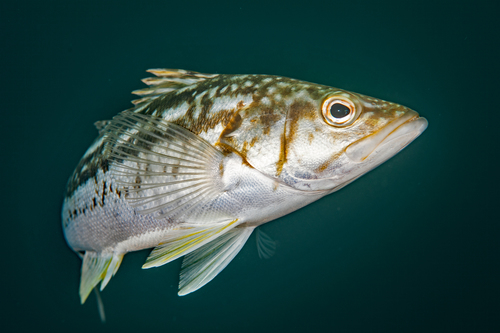
Kelp Bass
Paralabrax clathratus
A majestic resident of the Pacific kelp forests, the Kelp Bass is as curious as it is camouflaged. With its iconic 'calico' spotting and bold demeanor, it is the undisputed king of the coastal reefs.
Quick Identification
Size
Typically 12–18 inches (30–45 cm), but can reach up to 28 inches (72 cm) and weigh over 14 pounds (6.4 kg).
Colors
Olive-brown to brownish-gray back with prominent white or cream-colored square blotches in a checkerboard pattern; pale belly and yellowish fins.
Key Features
- Distinctive white 'calico' blotches along the back and sides
- Third, fourth, and fifth dorsal spines are nearly equal in length
- Large mouth with a slightly protruding lower jaw
When You’ll See Them
Sightings on EverydayEarth
Jul 30, 2026
A Kelp Bass swims directly toward the camera, momentarily filling most of the frame before banking to the left and disappearing into the amber-colored kelp fronds. The rest of the scene shows the kelp forest swaying rhythmically in the ocean surge.
Jul 30, 2026
A vibrant underwater scene shows several fish species active around large pier pilings. Bright orange Garibaldi swim prominently between the columns, while schools of small, dark Blacksmith Chromis dart through the open water. A mottled Kelp Bass is also visible cruising through the lower portion of the frame.
Jul 26, 2026
A vibrant underwater scene showing a variety of fish swimming among barnacle-encrusted pier pilings. Several Kelp Bass cruise near the structures, while bright orange Garibaldi and a large male California Sheephead move through the background. Schools of small, dark Blacksmith are scattered throughout the water column.
Jul 25, 2026
A diverse community of temperate reef fish swims among large, encrusted pier pilings. A large California Sheephead and several bright orange Garibaldi are prominent as they navigate the water column, while schools of Blacksmith and individual Kelp Bass drift in the background and between the structures.
Jul 24, 2026
Sunlight filters through the water column between massive pier pilings in Big Fisherman Cove. A diverse community of temperate reef fish is active, including bright orange Garibaldi and a large male California Sheephead that swims directly toward and past the lens. Several Kelp Bass hover in the current, while a school of small Blacksmith moves in the background.
Jul 24, 2026
Various species of temperate reef fish swim around submerged pier pilings covered in marine growth. A male California Sheephead, several Kelp Bass, and Opaleye are seen navigating the water column in the clear, sunlit marine environment.
Geographic range
Where Does the Kelp Bass Live?
The Kelp Bass is a signature species of the eastern North Pacific Ocean, found predominantly along the western coast of North America. Its range begins in the north near Washington state and extends down through the temperate waters of Central and Southern California, reaching its highest population density in the bight between Point Conception and Magdalena Bay in Baja California, Mexico. They are a resident species that stays close to the coastline throughout their entire life cycle.
Basemap © OpenStreetMap contributors
Recorded on EverydayEarth
Behavior
Kelp Bass are inquisitive and territorial predators that are synonymous with the underwater forests of the Pacific coast. Unlike many skittish fish, they are known for their 'bold' personality, often hovering nearly motionless in the water column to observe divers or potential prey. While younger fish tend to school for safety, mature 'bull' bass are solitary and highly protective of their preferred hunting grounds among the kelp stalks.
These fish are masters of suspension, utilizing their swim bladders to hang perfectly still at various depths within the giant kelp canopy. They are primarily active during the day, using the shifting shadows of the kelp fronds as cover for ambush attacks. In areas where they are frequently encountered by humans, such as marine protected areas or popular diving spots, they can become remarkably accustomed to people, sometimes approaching cameras out of pure curiosity.
EverydayEarth exclusive
Camera Tips
To capture Kelp Bass on an AI-powered underwater camera, placement is everything. These fish are 'structure-oriented,' meaning they rarely wander into open, sandy areas. Position your camera near the edge of a kelp bed or adjacent to a rocky outcrop. Mounting the camera 3 to 5 feet off the seafloor on a weighted tripod or a pier piling usually provides the best field of view, as it captures the bass as they patrol the mid-water column.
Using a scent-based attractant is the most effective way to bring Kelp Bass into frame. A small, perforated bait box filled with crushed sardines or squid will create a 'chum slick' that draws them in from down-current. Because they are curious, they will often stay to investigate the camera itself long after the scent has dissipated. Ensure your camera is set to a high frame rate (at least 60fps) to catch their lightning-fast strikes when they target prey.
Natural lighting is your best friend for this species. Try to angle your camera so it faces away from the direct morning sun to avoid lens flare, but benefit from the overhead light that penetrates the kelp canopy. Between 10 AM and 2 PM, the light 'god rays' filtering through the kelp create a stunning cinematic backdrop for the calico patterns of the bass. If you are filming in deeper water or under thick canopy, consider using a gentle LED fill light to bring out the yellowish tones in their fins.
Similar Species
Species that look similar or are commonly confused with Kelp Bass.
Frequently Asked Questions
Record Kelp Bass at your habitat
Connect a camera to start building your own species record — AI identifies every visitor automatically.