Barrow's Goldeneye
Bucephala islandica
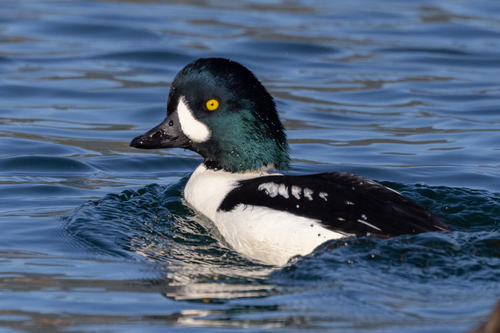
A striking diving duck with a 'bull-headed' silhouette and a crescent-shaped facial patch, Barrow's Goldeneye is a gem of the North. Whether diving for insects in alpine lakes or wintering in coastal estuaries, these resilient birds are a masterclass in aquatic agility.
Quick Identification
Size
40-48 cm (16-19 in) long; 70-80 cm (27-31 in) wingspan; 600-1,300 g (1.3-2.9 lbs)
Colors
Males feature an iridescent purplish-black head with a white crescent patch; females are gray-bodied with a chocolate brown head and bright yellow-tipped bills.
Key Features
- White crescent-shaped patch between the eye and bill on males
- Steep, bulbous forehead with a short, stubby bill
- Row of white square spots on the male's black back
- Male's head has a distinct purple sheen in sunlight
When You’ll See Them
Geographic range
Where Does the Barrow's Goldeneye Live?
Barrow's Goldeneye is primarily a specialist of the North American West, with its heartland stretching from the rugged coasts of Alaska through British Columbia and down into the Rocky Mountains of the United States. A separate, smaller population resides in Eastern Canada, specifically around the Gulf of St. Lawrence in Quebec. Beyond North America, this species is famously native to Iceland, which serves as its only major stronghold in the Atlantic and the only place in Europe where the species regularly breeds.
Basemap © OpenStreetMap contributors
Behavior
In the winter, they transition to a more social lifestyle, forming small, tight-knit flocks in coastal bays and ice-free rivers. Their courtship displays are particularly energetic, with males performing head-flicking, neck-stretching, and water-kicking maneuvers to attract females. They are also unique as cavity nesters, often competing with squirrels or other birds for old woodpecker holes or high-quality nesting boxes near the water's edge.
EverydayEarth exclusive
Camera Tips
To capture high-quality footage of Barrow's Goldeneye, prioritize water-level placement. If you have access to a shoreline, mount your camera on a short stake or a low-profile tripod only a few inches above the ground. Position it facing a known 'loafing' spot—typically a flat rock or a partially submerged log—where these ducks climb out to preen and rest. These stationary moments provide much clearer images than when the birds are bobbing on choppy water.
If you are trying to capture breeding behavior, installing a nesting box is the single most effective strategy. Barrow's Goldeneyes are secondary cavity nesters, meaning they look for pre-existing holes. Place a large-entrance nesting box 10 to 20 feet up a tree near a lake, and mount your camera on a neighboring branch or trunk facing the entrance. This setup can capture incredible 'leap of faith' footage when the ducklings exit the nest for the first time.
Because of the male's iridescent purple head, camera angle relative to the sun is vital. Try to position your camera with the sun at its back (facing North or East in the afternoon) to ensure the light hits the feathers at the right angle to reveal those hidden colors. Use a high shutter speed or 'Sports Mode' if your camera allows it, as their diving and surfacing happens quickly and can easily become a blur in low-light conditions.
Similar Species
Species that look similar or are commonly confused with Barrow's Goldeneye.
Common Goldeneye
The male Common Goldeneye has a round facial spot instead of a crescent and a more greenish-black head sheen.
Bufflehead
Much smaller in size with a large white patch on the back of the head rather than in front of the eye.
Hooded Merganser
Features a thin, serrated bill and a large, fan-shaped crest that can be raised or lowered.
Frequently Asked Questions
Record Barrow's Goldeneye at your habitat
Connect a camera to start building your own species record — AI identifies every visitor automatically.