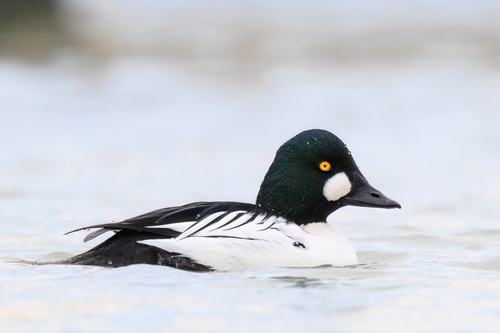
Common Goldeneye
Bucephala clangula
Meet the 'Whistler' of the waterways, a striking diving duck known for its bright yellow eyes and remarkable underwater hunting skills. Whether nesting in trees or diving in icy rivers, the Common Goldeneye is a master of the boreal wild.
Quick Identification
Size
Length: 40–51 cm (16–20 in); Wingspan: 77–83 cm (30–33 in); Weight: 800–1,200 g (1.8–2.6 lbs)
Colors
Males feature a dark iridescent green head with a round white spot near the bill and a bright white body with a black back. Females have a chocolate-brown head and a mottled gray body.
Key Features
- Distinctive round white spot at the base of the male's bill
- Bright golden-yellow irises in both sexes
- Bulbous, peaked head shape
- Wings produce a loud, rhythmic whistling sound in flight
- Cavity-nesting behavior in old trees
When You’ll See Them
Geographic range
Where Does the Common Goldeneye Live?
The Common Goldeneye is a circumpolar species native to the Northern Hemisphere, spanning across North America, Europe, and Asia. In the summer, they occupy a vast breeding range across the boreal forests of Canada, Alaska, Scandinavia, and Northern Russia. As winter approaches, they migrate to ice-free waters throughout the continental United States, southern Europe, and coastal East Asia, making them one of the most widespread diving ducks in the world.
Basemap © OpenStreetMap contributors
Behavior
Common Goldeneyes are energetic diving ducks known for their constant activity and impressive underwater agility. During the breeding season, they are surprisingly solitary for ducks, often nesting in tree cavities or man-made boxes near forested lakes. In the winter, they gather in small, loose flocks on larger bodies of water. One of their most famous traits is the 'whistling' sound created by their wings during flight, which can often be heard before the bird is even seen.
These birds are wary of humans and will often take flight or dive if approached too closely. However, they are a favorite for backyard birders who live near open water or those who install nest boxes in appropriate habitats. During courtship, males perform elaborate displays, including a dramatic 'head-throw' where they snap their heads back toward their tails while kicking water into the air.
EverydayEarth exclusive
Camera Tips
Capturing the Common Goldeneye on camera requires focusing on their unique nesting or foraging habits. If you live near a wooded lake or slow-moving river, the most effective strategy is to install a specialized wood duck nest box about 10 to 20 feet high on a tree trunk or a pole. Position your AI-powered camera on a nearby branch or a secondary pole aimed directly at the entrance hole. Use a side-angle to capture the 'take-off' and 'landing' maneuvers, as these birds fly directly into the cavity with surprising speed.
For winter monitoring on shorelines, place your camera on a tripod at a low-profile height, roughly 1 to 2 feet above the water level. This 'duck's-eye view' provides much more intimate and professional-looking footage than a steep downward angle. Since Goldeneyes are diving ducks, they won't come to traditional bird feeders. Instead, focus on areas with submerged logs or rocky outcrops where they might haul out to preen. Natural 'lures' like a clear patch of water in an otherwise frozen pond are magnetic for this species during the coldest months.
Lighting is crucial because of the high-contrast white plumage on the males. Set your camera to a slightly lower exposure (EV -0.3 or -0.7) if possible to prevent the white feathers from 'blowing out' in direct sunlight. High-speed shutter settings or high-frame-rate video (60fps+) are recommended to capture the rapid wing beats that give this bird its 'whistler' nickname. Early morning light often highlights the iridescent green sheen on the male's head, which can otherwise look plain black in flat or overcast lighting.
Similar Species
Species that look similar or are commonly confused with Common Goldeneye.
Barrow's Goldeneye
The male has a crescent-shaped face patch and a steeper forehead; they are more common in western mountainous regions.
Bufflehead
Significantly smaller with a large white patch on the back of the head rather than a small spot near the bill.
Hooded Merganser
Features a thin, serrated bill and a large, collapsible fan-like crest on the head.
Frequently Asked Questions
Record Common Goldeneye at your habitat
Connect a camera to start building your own species record — AI identifies every visitor automatically.