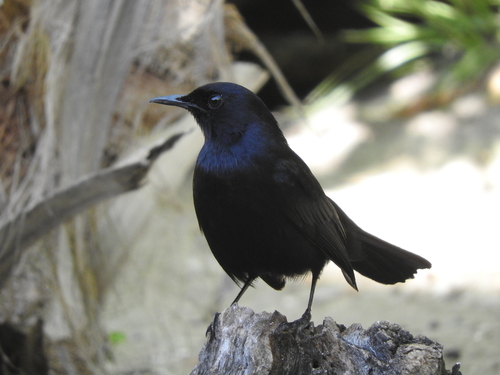
Black Catbird
Melanoptila glabrirostris
A hidden gem of the Yucatán, the Black Catbird is a sleek, shimmering songbird that brings a touch of midnight elegance to the tropical scrub. Known for its complex mimicry and secretive nature, it is a prize find for any backyard observer.
Quick Identification
Size
19–20.5 cm (7.5–8.1 in) in length; weight ranges from 31.6–42 g (1.11–1.48 oz)
Colors
Uniformly glossy black plumage with a blue or violet iridescent sheen; black legs and bill; dark brownish to reddish eyes.
Key Features
- Smallest member of the mimid family
- Glossy jet-black feathers with a subtle metallic sheen
- Long, expressive tail often flicked or cocked
- Dark, reddish-brown iris in adults
When You’ll See Them
Geographic range
Where Does the Black Catbird Live?
Native to the coastal regions of the Yucatán Peninsula, the Black Catbird is a regional specialty found in southeastern Mexico, northern Belize, and northern Guatemala. It is most frequently encountered on offshore islands like Cozumel and Ambergris Caye, where it thrives in the scrubby vegetation. Though historical records once placed them in Honduras and even Texas, they are now considered a sedentary resident of this specific Central American corridor.
Basemap © OpenStreetMap contributors
Behavior
The Black Catbird is a somewhat secretive but energetic songbird. Unlike its more famous relative, the Gray Catbird, this species is much more restricted in range and prefers staying within the safety of dense undergrowth. It is a master of mimicry, capable of weaving the calls of other birds into its own complex, warbling song, which is often performed from hidden perches within the thicket.
Socially, they are usually seen alone or in pairs. While they are not overly aggressive, they are highly territorial during the breeding season. They spend a significant amount of time on or near the ground, hopping through leaf litter to find food. Though they can be shy, they are curious birds and may approach a quiet observer if they feel secure in their cover.
EverydayEarth exclusive
Camera Tips
To capture the Black Catbird, placement is everything. These birds are understory specialists, so position your camera low to the ground—between 1 and 3 feet high. Target areas where dense thickets meet a small clearing or a garden path, as they often hop along these edges while foraging for insects in the leaf litter.
The absolute best way to attract a Black Catbird to your camera is with a water feature. A low-profile birdbath or a solar-powered dripper in a shaded area is irresistible to them, especially in the drier parts of the Yucatán. Set your camera 4 to 6 feet away from the water source to ensure the bird fills the frame without losing focus.
Because their plumage is so dark, capturing detail can be tricky. Try to position the camera so it catches the soft, angled light of the early morning. This side-lighting will reveal the stunning blue and violet iridescence of their feathers, which often looks flat black in harsh midday sun or deep shade. Use a fast trigger speed, as these birds are quick and twitchy.
If you are using a bait-style setup, small native fruits or mealworms placed on a flat stone can work well. However, they are naturally curious, so even an interesting branch or a pile of fresh mulch can draw them in to investigate. Ensure your camera is set to take a burst of 3-5 photos to capture their rapid tail-flicking movements.
Similar Species
Species that look similar or are commonly confused with Black Catbird.
Frequently Asked Questions
Record Black Catbird at your habitat
Connect a camera to start building your own species record — AI identifies every visitor automatically.