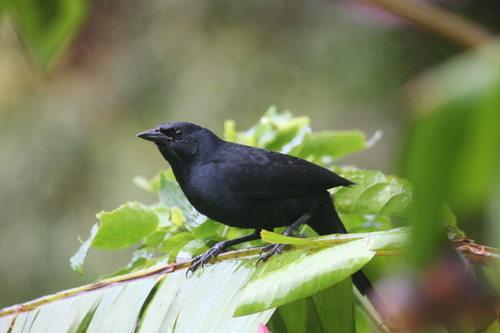
Melodious Blackbird
Dives dives
A master of song and adaptability, the Melodious Blackbird is a charismatic resident of Central American landscapes. Known for its glossy black plumage and stunning vocal duets, this clever bird is a favorite for backyard observers.
Quick Identification
Size
25–28 cm (10–11 in) long; weight between 90–105 g (3.2–3.7 oz)
Colors
Uniformly glossy black plumage with a faint blue-green sheen; black bill, legs, and feet; dark brown eyes
Key Features
- Entirely black plumage with no wing bars or patches
- Thick, pointed black bill with a slightly curved culmen
- Squared-off tail of medium length
- Melodious, whistling song often performed in duets
When You’ll See Them
Geographic range
Where Does the Melodious Blackbird Live?
Native to the tropical regions of North and Central America, the Melodious Blackbird thrives primarily along the Gulf-Caribbean slope. Its core range spans from eastern and southern Mexico through the countries of Belize, Guatemala, Honduras, and El Salvador, reaching into northern Nicaragua. In recent years, the species has successfully expanded its presence into Costa Rica, following the development of open agricultural land.
Basemap © OpenStreetMap contributors
Behavior
The Melodious Blackbird is renowned for its exceptional vocal abilities, living up to its name with a wide array of musical whistles, gurgles, and clear notes. Unlike many other blackbird species where only the male sings, both sexes of the Melodious Blackbird are accomplished singers and frequently engage in complex, synchronized duets to defend their territory or strengthen their pair bond.
Socially, these birds are typically found in pairs or small family groups rather than the massive flocks seen in other icterids like grackles. They are bold and intelligent, often adapting well to the presence of humans. In suburban settings, they can be seen hopping across lawns with a characteristic upright posture, searching for food or perching prominently on fence posts and power lines to sing.
EverydayEarth exclusive
Camera Tips
To capture the best footage of Melodious Blackbirds, place your AI-powered camera near ground-level features. These birds are enthusiastic bathers, so a shallow birdbath or a slow-dripping water feature is perhaps the best way to lure them into a stationary position. Set your camera at a height of about 12 to 18 inches, angled slightly upward to capture the bird's full profile as it drinks or bathes.
For feeding stations, avoid standard hanging tube feeders which can be difficult for them to navigate. Instead, use platform feeders or ground trays. Offering high-protein items like mealworms or suet will keep them in the camera's field of view longer than seeds will. They are also highly attracted to fruit; try securing half an orange or a piece of overripe banana to a low-hanging branch or a specialized fruit stake within 3 to 5 feet of your camera lens.
Since their plumage is entirely black, capturing detail can be tricky in high-contrast lighting. Try to position your camera in an area that receives consistent, soft light—such as under a canopy or on the north side of a building—to prevent the bird from appearing as a featureless black silhouette. If your camera allows for exposure adjustment, slightly underexposing the image can help preserve the subtle blue-green iridescence of their feathers. Because they are vocal birds, ensure your camera's microphone is active to capture their distinctive duets, which add a wonderful layer of context to your wildlife recordings.
Similar Species
Species that look similar or are commonly confused with Melodious Blackbird.
Great-tailed Grackle
Much larger with a longer, keel-shaped tail and bright yellow eyes in males.
Bronzed Cowbird
Thicker-necked with distinct red eyes and a shorter, more finch-like bill.
Red-winged Blackbird
Males have bright red and yellow shoulder patches; females are heavily streaked and brown.
Frequently Asked Questions
Record Melodious Blackbird at your habitat
Connect a camera to start building your own species record — AI identifies every visitor automatically.