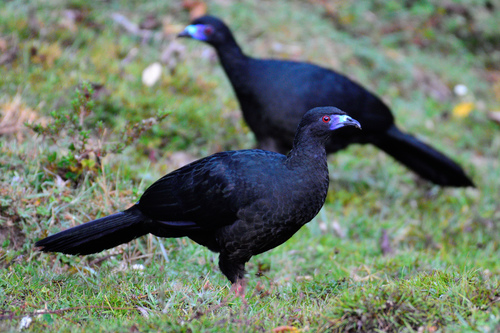
Black Guan
Chamaepetes unicolor
A striking specialty of the Central American highlands, the Black Guan is an elegant, charcoal-colored bird known for its vivid blue face and bright red legs. Found only in the cloud forests of Costa Rica and Panama, this gentle giant is a favorite for backyard observers in high-altitude regions.
Quick Identification
Size
62-70 cm (24-28 in) in length; weighs approximately 1.1-1.3 kg (2.4-2.9 lbs)
Colors
Uniformly glossy black plumage with a slight greenish sheen; bright blue bare facial skin around the eyes; pale iris and striking coral-red to pink legs.
Key Features
- Glossy black plumage without a crest
- Vibrant blue bare skin around the eye
- Bright red or coral-pink legs and feet
- Large, turkey-like silhouette
- Deep reddish-brown or pale eyes
When You’ll See Them
Geographic range
Where Does the Black Guan Live?
The Black Guan is a regional specialty native to the narrow mountainous backbone of Central America. Its core range is strictly limited to the highland cordilleras of Costa Rica and western Panama, particularly within the Talamancan montane forest ecoregion. Within these countries, it is a sedentary resident, rarely moving far from the mist-shrouded peaks where it finds its preferred fruiting trees.
Basemap © OpenStreetMap contributors
Behavior
The Black Guan is a charismatic and surprisingly bold resident of the misty highlands. Unlike many of its more skittish relatives in the Cracidae family, this species is often quite approachable, particularly in protected areas or near eco-lodges where it has become accustomed to human presence. While primarily arboreal, they are frequently seen descending to the lower canopy or even the forest floor to forage for fallen fruits and berries.
Socially, they are most often encountered in pairs or small family groups of three to four individuals. During the breeding season, which typically runs from February to June, males perform a remarkable mechanical display known as 'wing-drumming.' They fly between trees, beating their wings in a rhythmic, muffled rattling sound that echoes through the cloud forest. They are generally quiet birds but can produce a high-pitched, thin whistle when communicating with their mate or offspring.
EverydayEarth exclusive
Camera Tips
To capture high-quality footage of a Black Guan, focus your camera placement on horizontal limbs in the mid-canopy or near known 'fruiting corridors.' These birds follow consistent paths through the forest to reach wild avocado trees. If your property has fruiting shrubs like those in the Melastomataceae family, placing a camera 3-5 feet off the ground facing a clear patch of the forest floor nearby can capture them as they hop down to retrieve fallen berries.
Because the cloud forest is often dimly lit, ensure your camera has a high-quality sensor capable of handling low-light conditions without excessive grain. A fast trigger speed is less critical for these slow-moving birds than for mammals, but a long video duration (20-30 seconds) is ideal to capture their deliberate feeding behavior and social interactions. If you are lucky enough to live near a display site during the spring, aim your camera at open gaps between large trees to catch their unique wing-drumming flights.
While they aren't traditional 'feeder' birds, they are highly attracted to water sources in the dry season and elevated platforms containing fruit scraps like bananas or papaya. Mount your camera at eye level with the platform, roughly 6-8 feet away, to get the best detail of their striking blue facial skin and red legs. Avoid pointing the lens directly into the rising or setting sun, as the mist in their habitat can cause significant glare and wash out the bird's dark plumage.
Similar Species
Species that look similar or are commonly confused with Black Guan.
Frequently Asked Questions
Record Black Guan at your habitat
Connect a camera to start building your own species record — AI identifies every visitor automatically.