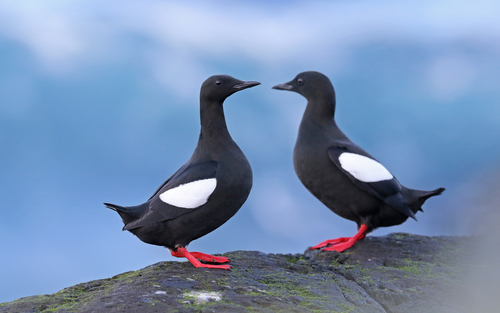
Black Guillemot
Cepphus grylle
With their striking jet-black feathers and vibrant coral-red feet, Black Guillemots are the 'gentlemen' of the rocky northern coasts. Often found whistling from shoreline boulders, these charismatic divers bring a splash of color to the rugged Atlantic landscape.
Quick Identification
Size
Length: 30–38 cm (12–15 in); Wingspan: 52–58 cm (20–23 in); Weight: 320–550 g (11–19 oz)
Colors
Breeding adults are jet-black with large white wing patches and bright coral-red legs and inner mouth. Winter plumage is mottled grey and white, but the white wing patch remains a constant identifier.
Key Features
- Bold white oval wing patches on dark wings
- Bright coral-red legs and feet
- Slender, pointed black bill
- High-pitched whistling vocalizations
When You’ll See Them
Geographic range
Where Does the Black Guillemot Live?
The Black Guillemot is a quintessential bird of the Northern Hemisphere's cold-water coasts, stretching across the North Atlantic and Arctic Oceans. These hardy birds are native to the rugged shorelines of North America, Europe, and Russia, with significant populations found from the northeastern United States and Canada over to the British Isles, Scandinavia, and Iceland. While many remain year-round residents near their breeding grounds, northernmost populations migrate south just far enough to find ice-free waters during the harsh winter months.
Basemap © OpenStreetMap contributors
Behavior
Black Guillemots, often affectionately called 'tysties,' are charming and approachable seabirds that differ from many of their cousins by preferring smaller, more intimate colonies. Unlike the massive, noisy 'bird cities' of Common Murres, these birds often nest in small groups or solitary pairs within rocky crevices or under large boulders along the shoreline. They are highly vocal during the breeding season, communicating with high-pitched whistles that carry clearly over the sound of the waves.
As skilled divers, they use their wings to 'fly' underwater, reaching depths of up to 50 meters to hunt along the sea floor. They are strictly diurnal and spend a significant portion of their day perched on rocks near the water's edge, preening or displaying their bright red gapes to potential mates. While they are wary of predators like large gulls and minks, they can be remarkably tolerant of humans who approach quietly, making them a favorite for coastal wildlife observers and photographers.
EverydayEarth exclusive
Camera Tips
Capturing the Black Guillemot on camera requires a strategy focused on their specific nesting and perching habits. Unlike many seabirds that nest on sheer cliff faces, 'tysties' prefer nesting in crevices or under large boulders at the base of cliffs. If you have access to a rocky shoreline, look for white guano streaks near rock fissures or flat-topped 'staging' rocks where the birds gather to socialise before heading to sea. Position your camera about 2-3 feet off the ground, angled slightly upward to capture the birds as they emerge from their nests or stand on their lookout posts.
Because these birds are active during the day, standard motion-sensing cameras work well, but you’ll want a fast trigger speed to freeze the motion of their rapid wingbeats. If you are setting up near a suspected nest site, ensure your presence is brief and occurs well before the breeding season begins to avoid disturbing the pair. No bait is necessary or recommended; instead, identify their natural 'loafing' spots where they rest and preen between fishing trips. These are often flat, prominent rocks with a clear view of the water.
Pay close attention to the lighting, as the high contrast between their jet-black summer plumage and bright white wing patches can often 'blow out' the white details in bright midday sun. Early morning or late afternoon light provides a softer glow that highlights the vibrant red of their feet and the subtle texture of their feathers. If your camera allows for manual exposure, a slight underexposure can help preserve the detail in those iconic white wing patches. During the winter, remember that their appearance changes drastically to a mottled white, so look for those consistent white wing patches to confirm your ID.
Similar Species
Species that look similar or are commonly confused with Black Guillemot.
Pigeon Guillemot
Found in the Pacific rather than the Atlantic; features a dark 'wedge' in the middle of its white wing patch.
Common Murre
Larger, lacks the white wing patches, and typically nests in much larger, denser colonies on open cliff ledges.
Razorbill
Features a much thicker, blunt-ended bill with white vertical lines and lacks the coral-red feet of the guillemot.
Frequently Asked Questions
Record Black Guillemot at your habitat
Connect a camera to start building your own species record — AI identifies every visitor automatically.