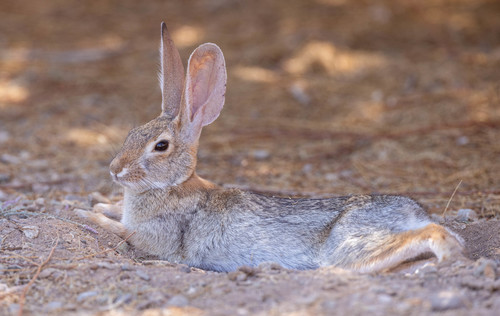
Desert Cottontail
Sylvilagus audubonii
The Desert Cottontail is the ultimate arid-land survivor, known for its iconic white tail and its ability to disappear into the desert landscape in the blink of an eye.
Quick Identification
Size
33-43 cm (13-17 in) in length; weighing 0.7-1.4 kg (1.5-3 lbs)
Colors
Pale grayish-brown with a subtle yellow-orange wash; white belly and pure white underside of the tail
Key Features
- Large ears (3-4 inches) with hairless inner surfaces
- Distinctive white 'cotton' tail
- Orange-buff patch on the nape of the neck
- Long, slender hind legs compared to other cottontails
When You’ll See Them
Geographic range
Where Does the Desert Cottontail Live?
The Desert Cottontail is native to the western half of North America, spanning from the Great Plains in the north down into central Mexico. Its core range includes the vast American West, stretching from Montana and Idaho through the high deserts of Utah and Nevada, and across the Southwest into Texas and California. While they are most abundant in these arid regions, they have successfully adapted to suburban parklands and agricultural edges throughout the western United States.
Basemap © OpenStreetMap contributors
Behavior
Desert Cottontails are primarily crepuscular, meaning they are most active during the cool transition hours of dawn and dusk. Unlike many other rabbit species, they are surprisingly agile and have been observed climbing slanting trees or low bushes to reach succulent new growth or escape ground-level predators. They are generally solitary animals, but they exhibit a high level of social tolerance, often feeding in small, peaceful groups when food is abundant.
When a Desert Cottontail senses danger, its first instinct is to freeze perfectly still, pressing its body into the dirt to let its camouflaged fur blend with the arid landscape. If the threat approaches too closely, it will bolt in a lightning-fast zigzag pattern toward a thicket or an abandoned burrow. In suburban environments, they often become remarkably bold, taking up residence under decks or in dense ornamental hedges where they feel safe from hawks and coyotes.
EverydayEarth exclusive
Camera Tips
To successfully capture Desert Cottontails on camera, placement is everything. Position your camera very low to the ground—roughly 10 to 15 inches high—and angle it slightly downward. These rabbits spend most of their time with their noses to the earth, so a high-mounted camera will often miss the facial details and expressive ears that make for a great shot. Look for 'rabbit runs,' which are subtle, narrow paths worn through the grass or dirt leading into dense bushes, and set your camera perpendicular to these trails.
Because they are most active during the low-light hours of dawn and dusk, your camera's trigger speed is vital. Choose a model with a trigger speed under 0.5 seconds to avoid capturing just a disappearing white tail. If you are using a trail camera in a backyard, placing a low-profile water dish in a semi-sheltered area is the single most effective way to attract them, especially during the hot summer months. They will also visit areas with fallen fruit or clover patches.
During the spring breeding season, switch your camera to video mode. Desert Cottontails engage in fascinating social behaviors, including 'cavorting' where they jump over one another in a ritualized dance. Use a 15-20 second video clip length to capture these interactions. Ensure your infrared flash is set to 'Auto' so the camera can transition smoothly from the deep shadows of the brush into the brightening morning light without overexposing the rabbit's pale fur.
Similar Species
Species that look similar or are commonly confused with Desert Cottontail.
Eastern Cottontail
Very similar in appearance, but the Desert Cottontail has much larger ears that are more sparsely furred on the inside.
Black-tailed Jackrabbit
Much larger than the cottontail with significantly longer ears that feature black tips and a tail that is black on the top.
Mountain Cottontail
Found at higher elevations, it has shorter ears and more heavily furred feet than the Desert Cottontail.
Frequently Asked Questions
Record Desert Cottontail at your habitat
Connect a camera to start building your own species record — AI identifies every visitor automatically.