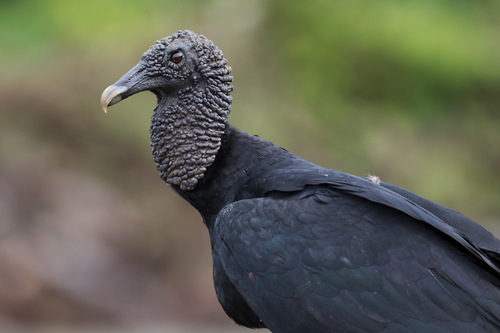
Black Vulture
Coragyps atratus
The Black Vulture is an essential part of the ecosystem's cleanup crew, known for its social intelligence and striking silhouette. Easily recognized by the silver patches on its wingtips, this bird is a master of the thermals.
Quick Identification
Size
Length: 56–74 cm (22–29 in); Wingspan: 1.3–1.6 m (4.3–5.2 ft); Weight: 1.6–3 kg (3.5–6.6 lbs)
Colors
Uniformly black plumage with silvery-white patches at the wing tips; dark gray, unfeathered, wrinkled skin on the head and neck; dark gray legs.
Key Features
- Broad, rounded wings with white 'stars' on the tips
- Short, squared-off tail
- Dark gray, featherless, wrinkled head skin
- Soars with wings held flat, unlike the 'V' shape of similar species
When You’ll See Them
Geographic range
Where Does the Black Vulture Live?
The Black Vulture is a native resident of the Americas, occupying a vast territory that stretches from the northeastern and southeastern United States through Mexico and Central America. Its range continues deep into South America, reaching as far south as central Chile and Uruguay, with particularly high densities throughout the diverse landscapes of Brazil. While they were historically more common in warmer southern latitudes, their range is steadily expanding northward into the Mid-Atlantic and New England regions of the U.S. as they adapt to changing climates and human-altered landscapes.
Basemap © OpenStreetMap contributors
Behavior
Black Vultures are highly social birds that are often found in large communal roosts or feeding groups. Unlike their cousins, the Turkey Vultures, they lack a highly developed sense of smell and often follow other scavengers to find food. Once a carcass is located, Black Vultures are known for their aggressive behavior, frequently outcompeting other birds through sheer numbers and assertive posturing.
These birds are exceptionally intelligent and exhibit strong family bonds. They are often seen 'sun-bathing' with their wings spread wide, a behavior thought to dry feathers, regulate body temperature, and kill bacteria from their last meal. In suburban environments, they have adapted well to human presence, often congregating near landfills, roadsides, and even on the roofs of houses, though they remain wary of direct human interaction.
EverydayEarth exclusive
Camera Tips
To capture high-quality footage of Black Vultures, focus on placing your camera in open areas with high visibility. Because these birds are large and often travel in groups, set your camera at a wide angle to ensure you capture the entire flock. If you have a large backyard or farm, mounting the camera on a fence post or a low tree limb (3-5 feet high) facing a clear patch of ground is ideal, as they spend significant time on the earth while feeding or socializing.
Since Black Vultures are diurnal, you don't need night-vision capabilities, but you should prioritize a camera with a fast trigger speed and 'Burst Mode.' These birds are very active and communicative; capturing a sequence of photos or a long video clip will help you see their unique social behaviors, such as wing-spreading or displacement displays. Avoid pointing the camera directly toward the sun, as their dark plumage can easily become a featureless silhouette in high-contrast lighting.
If you live in an area where it is legal and safe to do so, placing scraps of meat or a small carcass can attract them quickly. However, even without bait, they are often drawn to large water troughs or shallow ponds for drinking and bathing. Placing a camera near a water source during the hottest part of the day (11 AM to 3 PM) is one of the most reliable ways to get close-up, detailed shots of their distinctive wrinkled heads and powerful beaks.
Similar Species
Species that look similar or are commonly confused with Black Vulture.
Turkey Vulture
Has a bright red head (in adults), a longer tail, and holds its wings in a distinct 'V' shape while soaring.
California Condor
Much larger with a massive 9-foot wingspan and an orange/yellow head skin.
Common Raven
Smaller with fully feathered heads, wedge-shaped tails, and different flight patterns.
Frequently Asked Questions
Record Black Vulture at your habitat
Connect a camera to start building your own species record — AI identifies every visitor automatically.