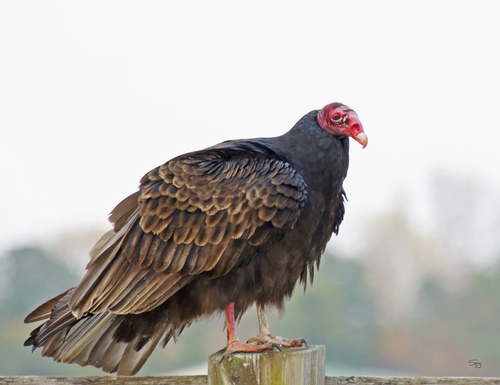
Turkey Vulture
Cathartes aura
The Turkey Vulture is a master of the skies, using a keen sense of smell and massive wingspan to patrol the landscape. More than just a scavenger, this 'Peaceful Purifier' is a fascinating and essential part of our backyard ecosystems.
Quick Identification
Size
Wingspan of 63–72 inches (160–183 cm); Length of 24–32 inches (62–81 cm); Weight of 1.8–5.3 lbs (0.8–2.41 kg)
Colors
Adults have brownish-black plumage with a featherless red head; juveniles have a grey-black head; underwings show distinct silvery-grey flight feathers
Key Features
- Featherless red head in adults
- Distinctive V-shaped 'dihedral' flight profile
- Silver-grey flight feathers visible from below
- Unsteady, teetering flight style
- Ivory-colored hooked beak
When You’ll See Them
Sightings on EverydayEarth
Aug 1, 2026
A Turkey Vulture is perched on a dead tree snag overlooking the golden, brush-covered hills. The bird remains largely stationary, occasionally turning its head to scan the surrounding landscape under a clear blue sky.
Jul 31, 2026
A California Condor is perched majestically on a wooden support beam of a sanctuary enclosure, overlooking a steep, forested hillside. On the ground below the beam, two Turkey Vultures are seen moving around the dry grass and dirt, likely scavaging for scraps.
Jul 30, 2026
On a dry, grassy hillside in Big Sur, a group of large scavengers is gathered near a research building. Two Turkey Vultures are visible in the foreground and mid-ground, moving across the terrain. Further back, a California Condor stands prominently, identified by its large size and white neck ruff. The birds appear to be foraging or resting in the late afternoon sun.
Jul 30, 2026
A Turkey Vulture is perched on a high, bleached branch of a dead tree. It remains relatively still throughout the clip, occasionally shifting its weight and turning its head to survey the dry, hilly landscape of Big Sur under a bright, clear sky.
Jul 30, 2026
Several Turkey Vultures are seen foraging on a dry, grassy hillside. As the camera pans to the right, it reveals a large group of California Condors gathered around a carcass near a sanctuary enclosure. Some condors are perched on the fence while others interact on the ground.
Jul 29, 2026
A Turkey Vulture is perched on a branch of a large dead tree (snag), periodically turning its head to scan the surrounding mountainous terrain under a clear blue sky.
Behavior
Turkey Vultures are nature's ultimate cleanup crew, performing a vital ecological service by consuming carrion. Unlike most birds, they possess an incredibly sophisticated sense of smell, allowing them to locate decaying organic matter from miles away, even under a thick forest canopy. They are social birds, often seen roosting in large communal groups in dead trees or on structures, but they usually forage individually or in small, loose clusters.
One of their most iconic behaviors is 'horaltic pose,' where they stand with wings spread wide to bake off bacteria, dry their feathers, or regulate body temperature. While they may seem intimidating, they are actually quite gentle and lack a syrinx (vocal organ), meaning they can only produce low hisses or grunts. If threatened, their primary defense is a pungent projectile vomit intended to deter predators.
EverydayEarth exclusive
Camera Tips
Capturing high-quality Turkey Vulture footage requires an understanding of their reliance on thermal air currents. They typically don't take flight until the sun has warmed the earth enough to create rising air. For the best action shots, place your camera facing an open field or a clear ridge where they are likely to soar low while searching for food. If you have a tall, dead tree (snag) on your property, aim your camera upward at a 45-degree angle; these are prime 'sunning' spots where vultures spread their wings in the morning light.
While many backyard enthusiasts use birdseed, Turkey Vultures require a different approach. If local regulations and your stomach allow, placing a camera near natural carrion or raw meat scraps in an open area is the most effective way to trigger a recording. Position the camera on a sturdy post about 2 to 3 feet off the ground, angled slightly downward toward the bait. Ensure the area is clear of tall grass that might trigger the PIR sensor during windy conditions.
Because vultures often feed in groups and stay at a carcass for long periods, set your camera to 'Video' mode with a 20-30 second duration and a short trigger interval. This captures the fascinating social hierarchy and 'wing-slapping' displays that occur when multiple birds compete for a meal. For the best lighting, try to position the camera with the sun at your back, especially in the early morning when they are drying their wings.
Don't overlook the 'communal roost.' If you notice vultures frequenting a specific group of trees at dusk, a trail camera placed at the base of these trees can capture them landing and taking off. Use a high-end camera with a fast trigger speed (under 0.3 seconds) to catch the impressive 6-foot wingspan in motion without motion blur. In winter months, look for them on south-facing slopes or dark rooftops where they gather to soak up residual heat.
Similar Species
Species that look similar or are commonly confused with Turkey Vulture.
Black Vulture
Smaller with a black head; has white wing tips rather than silver along the whole trailing edge; flies with more frequent, rapid flaps.
Zone-tailed Hawk
A hawk that mimics the Turkey Vulture's flight style and color to sneak up on live prey; distinguished by its feathered head and yellow cere/feet.
Golden Eagle
Much larger with a fully feathered head; holds wings flatter while soaring and lacks the silver-grey underwing contrast.
Frequently Asked Questions
Record Turkey Vulture at your habitat
Connect a camera to start building your own species record — AI identifies every visitor automatically.