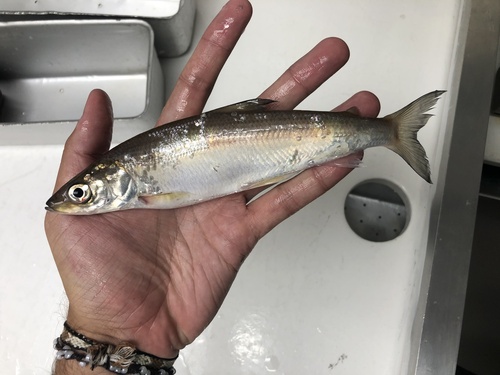
Bloater
Coregonus hoyi
Meet the Bloater, the silvery survivor of the Great Lakes' deepest trenches. This iridescent whitefish is a master of the dark, cold waters, playing a crucial role in the heart of the North American freshwater food web.
Quick Identification
Size
20-28 cm (8-11 inches) in length; weighs between 0.1-0.3 kg (4-11 oz)
Colors
Silvery overall with iridescent pink and purple reflections; dark greenish-blue back and a white underbelly
Key Features
- Compressed, silvery herring-like body
- Large eyes relative to head size
- Lower jaw usually shorter than or equal to the upper jaw
- Body appears 'bloated' when brought to the surface from depth
When You’ll See Them
Geographic range
Where Does the Bloater Live?
Native to the Great Lakes basin of North America, the Bloater is found across the vast freshwater inland seas of the United States and Canada. Its core range includes Lake Michigan, Lake Huron, and Lake Ontario, with significant populations also found in Lake Superior and Lake Nipigon. These fish are deep-water specialists, rarely venturing into shallow near-shore waters unless the water temperature is significantly low.
Basemap © OpenStreetMap contributors
Behavior
The Bloater is a deep-water specialist known for its unique physiological response to pressure changes. Residing primarily in the cold, dark depths of large lakes, these fish spend their days near the bottom and undergo a 'diel vertical migration' at night, rising higher in the water column to follow their prey. They are relatively slow swimmers and are known to be quite social, often traveling in loose schools along underwater slopes.
Their name originates from the fact that their gas bladder expands rapidly when they are caught and brought to the surface, giving them a swollen appearance. Unlike many other whitefish, the Bloater has managed to remain one of the most abundant deepwater ciscoes in the Great Lakes, serving as a primary food source for larger predators like Lake Trout and Salmon.
EverydayEarth exclusive
Camera Tips
Capturing the Bloater on camera requires a specialized underwater setup, as this species rarely inhabits depths shallow enough for standard trail cameras. For those living on Great Lakes waterfronts, use a submersible camera with high-definition video capabilities. The best placement is along a drop-off or underwater slope, ideally at depths of at least 15-20 meters if your equipment allows. Use a heavy anchor and a buoy system to ensure your camera remains stable against deep-water currents.
Lighting is the biggest challenge when filming Bloaters. Because they are most active during low-light hours and inhabit the dark 'twilight zone' of lakes, you will need powerful infrared (IR) or low-glow LED underwater lights. White lights can sometimes spook the fish, so IR is often preferred for more natural behavior. Position your lights at an angle to the camera lens to minimize the 'backscatter' caused by suspended sediment and plankton in the water.
To attract Bloaters into the camera's frame, use a perforated bait canister or a mesh bag filled with a scent-heavy attractant. Crushed krill, fish meal, or even canned tuna in oil works well to mimic the scent of their natural crustacean prey. Since Bloaters are sensitive to temperature, the best time for observation is during the late spring or fall when the water column is mixing and they may venture slightly shallower than their usual summer depths.
Similar Species
Species that look similar or are commonly confused with Bloater.
Frequently Asked Questions
Record Bloater at your habitat
Connect a camera to start building your own species record — AI identifies every visitor automatically.