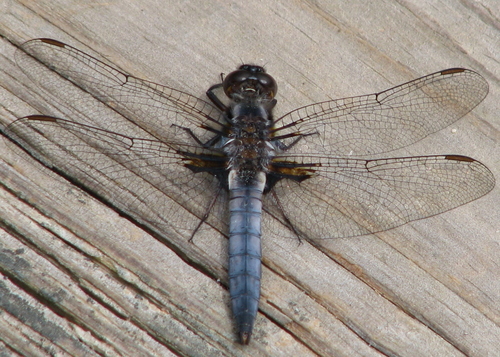
Blue Corporal
Ladona deplanata
A sure sign of spring, the Blue Corporal is a compact, powder-blue sentinel of the water's edge. Known for its unique habit of basking on sun-warmed logs, this early-season dragonfly is a favorite for backyard observers.
Quick Identification
Size
Length: 29–36 mm (1.1–1.4 in); Wingspan: 50–60 mm (2.0–2.4 in)
Colors
Mature males are pruinose (powdery) chalk-blue with a dark tip on the tail; females and juveniles are reddish-brown with two white stripes on the thorax.
Key Features
- Two dark basal spots at the base of each wing
- Chalky blue abdomen with a black tip (males)
- Two bold, pale stripes on the sides of the thorax
- Often perches flat on the ground or on logs
When You’ll See Them
Geographic range
Where Does the Blue Corporal Live?
Native to North America, the Blue Corporal is a quintessential inhabitant of the eastern United States. Its core territory stretches from the Atlantic coast of New Jersey south to Florida and reaches westward into the pine forests of Texas and Oklahoma. This species is particularly common in the Southeastern coastal plain, where it thrives in the warm, humid climate and abundant freshwater ecosystems near pine barrens.
Basemap © OpenStreetMap contributors
Behavior
The Blue Corporal is one of the earliest dragonflies to emerge in the spring, often appearing while the air is still crisp. Unlike many other dragonflies that prefer to perch on tall reeds or twigs, the Blue Corporal has a distinct habit of perching flat against sun-warmed surfaces such as rocks, logs, or even the bare ground. This behavior, known as 'obelisking' or simple flat-perching, helps them regulate their body temperature during the cooler early-season months.
These are highly territorial insects, though their 'battles' are usually brief aerial skirmishes. Males will stake out a section of a pond bank or a nearby sunny clearing, darting out to intercept passing insects or rivals before returning to the exact same perching spot. They are not particularly shy of humans, making them excellent subjects for backyard observation if you move slowly and avoid casting a shadow over them.
EverydayEarth exclusive
Camera Tips
To capture high-quality images of a Blue Corporal, you need to understand their 'flat' perching habit. Unlike many dragonflies that require cameras to be aimed upward into the reeds, you should position your AI-powered camera or trail cam low to the ground. Placing a weathered log or a flat, dark stone in a sunny spot near water is an excellent way to create a predictable landing pad. Aim the camera at a 45-degree angle toward this 'stage' to capture the detail on the abdomen and the characteristic wing spots.
Because they emerge in early spring, timing is everything. Set your camera to be most active during the warmest part of the day, typically between 10 AM and 3 PM. These dragonflies are solar-powered; they won't be active on overcast or very windy days. Using a camera with a fast shutter speed or a 'burst' mode is critical, as they can take flight in a fraction of a second when they spot prey.
If you are using a macro-capable AI camera, focus on the thorax. For the Blue Corporal, the distinguishing features are the two pale stripes on the thorax of females and the powdery blue 'pruinosity' of the males. Background blur (bokeh) is easily achieved by ensuring the perching spot is at least several feet away from dense vegetation, which helps the blue or brown body of the dragonfly pop against the background.
Similar Species
Species that look similar or are commonly confused with Blue Corporal.
Chalk-fronted Corporal
Larger than the Blue Corporal, with distinctive white patches on the front of the thorax rather than two side stripes.
Blue Dasher
Has vibrant green eyes and a striped thorax, whereas the Blue Corporal has darker eyes and a more uniform chalky blue body.
Eastern Pondhawk
Males are also blue but lack the two dark wing spots at the base, and females are bright green rather than brown.
Frequently Asked Questions
Record Blue Corporal at your habitat
Connect a camera to start building your own species record — AI identifies every visitor automatically.