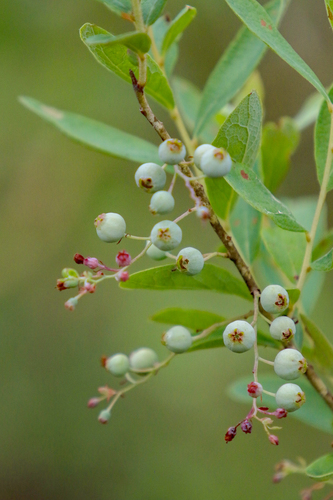
blue huckleberry
Gaylussacia tomentosa
A hidden gem of the Southern coastal plains, the blue huckleberry is a magnet for pollinators and songbirds. Recognized by its fuzzy stems and waxy blue fruit, it adds a touch of wild elegance to any sandy backyard.
Quick Identification
Size
Typically 0.6–1.2 meters (2–4 feet) tall with a similar spread
Colors
Dull green leaves, reddish-brown hairy stems, pinkish-white flowers, and dusty blue berries
Key Features
- Stems and twigs are densely covered in short, brownish hairs (tomentose)
- Bell-shaped flowers hang on long, slender stalks up to 2cm long
- Fruit is a glaucous blue berry with a distinct waxy coating
- Leaves have tiny, golden resin glands visible under a magnifying glass
When You’ll See Them
Geographic range
Where Does the blue huckleberry Live?
North America is the exclusive home of this specialized shrub, which is found primarily within the coastal plains of the southeastern United States. Its core range extends from southern Virginia through North Carolina, South Carolina, and Georgia, reaching down into the sandy peninsula of Florida. While it is a regional specialist, it is often found in abundance where fire-maintained pine ecosystems or sandy coastal ridges provide the acidic soil it requires.
Basemap © OpenStreetMap contributors
Behavior
The blue huckleberry is a colonial, deciduous shrub that defines much of the understory in the southeastern coastal plains. Unlike some plants that grow in isolated clumps, this species spreads via underground rhizomes to form loose thickets. It spends the winter in a dormant state, with its distinctive hairy, reddish-brown twigs providing a structural element to the landscape before leafing out in early spring.
As the season progresses, the plant exhibits a 'dangling' behavior where its flowers and subsequent fruits hang prominently below the foliage on exceptionally long pedicels. This makes the nectar and berries easily accessible to flying visitors. In the wild, these shrubs act as a primary food hub, timing their fruit ripening to coincide with the high-energy needs of mid-summer birds and small mammals.
EverydayEarth exclusive
Camera Tips
To capture the best images of the blue huckleberry and the wildlife it attracts, mount your camera on a low-profile stake approximately 12 to 18 inches above the ground. Angle the lens slightly upward to capture the 'dangle' of the blue berries or bell-shaped flowers against the sky or the green canopy. This perspective highlights the unique hanging structure that gives the plant its nickname, the hairy dangleberry.
During the spring bloom (March to May), use a high-sensitivity trigger setting or a time-lapse mode with short intervals (every 30 seconds) to catch native bees performing 'buzz pollination.' Since bees move quickly between flowers, a fast shutter speed is essential to prevent motion blur. In the summer months, when the blue fruit is ripe, switch your camera to a 3-shot burst mode. This is the best way to capture birds like the Brown Thrasher or Eastern Towhee as they land and manipulate the berries.
Position your camera to take advantage of 'golden hour' light in the early morning or late afternoon. The blue huckleberry's fruit has a waxy, glaucous coating that can look flat in midday sun but glows with a beautiful soft blue hue in angled light. Additionally, the side-lighting will make the fine hairs (tomentum) on the stems stand out, providing a professional-grade botanical detail to your captures.
Similar Species
Species that look similar or are commonly confused with blue huckleberry.
Frequently Asked Questions
Record blue huckleberry at your habitat
Connect a camera to start building your own species record — AI identifies every visitor automatically.