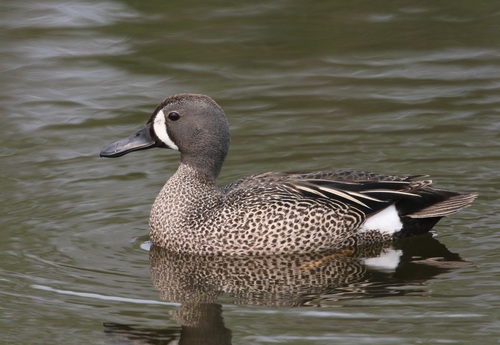
Blue-winged Teal
Spatula discors
With its striking white facial crescent and vibrant powder-blue wing patches, the Blue-winged Teal is a jewel of the wetlands. Small and lightning-fast, this early-migrating duck is a favorite for backyard pond watchers and birders alike.
Quick Identification
Size
Length: 36–41 cm (14–16 in); Wingspan: 56–62 cm (22–24 in); Weight: 280–500 g (10–18 oz)
Colors
Males have a blue-gray head with a white facial crescent; females are mottled brown. Both display a distinctive chalky-blue patch on the forewing.
Key Features
- Prominent white crescent on the male's face
- Large sky-blue wing patches visible in flight
- Small, compact body with a black bill
- Yellow-orange legs on adult males
- High-pitched whistling call
When You’ll See Them
Geographic range
Where Does the Blue-winged Teal Live?
Native to the North American continent, the Blue-winged Teal is a wide-ranging traveler that breeds from the northern reaches of Canada and Alaska down through the central United States. As one of the most migratory ducks in the Western Hemisphere, its winter range extends remarkably far, covering the southern United States, Mexico, and Central America, and reaching deep into South America as far as Peru and Brazil. This species is a true seasonal wanderer, often appearing in massive numbers in the Gulf Coast wetlands during its peak migration windows.
Basemap © OpenStreetMap contributors
Behavior
Blue-winged Teals are highly social and energetic dabbling ducks, often seen in small flocks or 'paddles' on the water. They are famous for being 'early birds' of the migration world, often starting their southward journey in late summer, long before other waterfowl. In flight, they are incredibly fast and agile, frequently performing synchronized twists and turns that make them a thrill to watch through a lens.
When foraging, they rarely dive, instead preferring to tip their heads underwater to reach vegetation or skim the surface with their bills. They are generally more skittish than Mallards and will take flight at the first sign of a predator or human disturbance. Despite this, they can become accustomed to quiet observers near suburban ponds or managed wetlands, especially during the spring breeding season when males are preoccupied with courtship displays.
EverydayEarth exclusive
Camera Tips
To capture the best footage of Blue-winged Teals, position your camera at the water's edge, ideally no more than 6 inches above the surface. This low-angle perspective creates a more intimate view and captures the beautiful reflections of the male's white facial crescent. Because these ducks prefer shallow water, look for mudflats or areas with emerging lily pads where they are likely to forage for seeds and insects.
Since Blue-winged Teals are fast movers, ensure your camera has a high trigger speed. If your AI camera allows for 'Burst Mode' or high-frame-rate video, enable it to catch the moment they stretch their wings, which is the best time to see the namesake blue wing patches. They are most active in the early morning light, which also provides the softest illumination for their subtle gray and brown plumage.
Avoid using heavy scents or loud equipment near their loafing spots, as they are naturally wary. If you are setting up a camera in a backyard with a pond, providing a small floating log can act as a natural 'stage.' Teals love to hop onto logs to preen their feathers, offering a stationary target for your camera's autofocus to lock onto. During late summer, keep your cameras running even if other ducks haven't arrived yet—the Blue-winged Teal is often the first visitor to show up during the fall migration.
Similar Species
Species that look similar or are commonly confused with Blue-winged Teal.
Cinnamon Teal
Males are bright reddish-orange rather than gray-headed; females are nearly identical but have less distinct facial markings.
Northern Shoveler
Much larger bill and bigger body, though it shares the same powdery blue wing patches.
Green-winged Teal
Smaller with a vertical white stripe on the shoulder (males) and lacks the blue wing patch in both sexes.
Frequently Asked Questions
Record Blue-winged Teal at your habitat
Connect a camera to start building your own species record — AI identifies every visitor automatically.