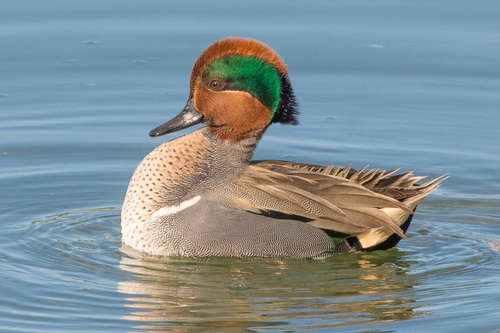
Green-winged Teal
Anas crecca
The Green-winged Teal is a vibrant, pint-sized marvel of the marshlands. Famous for its lightning-fast flight and striking iridescent plumage, this social duck is a favorite for backyard observers with a love for wetlands.
Quick Identification
Size
Length: 31–39 cm (12–15 in); Wingspan: 53–59 cm (21–23 in); Weight: 140–500 g (5–18 oz)
Colors
Males have a chestnut head with a green eye-patch and grey body; females are mottled brown. Both have a bright green speculum.
Key Features
- Smallest dabbling duck in the Northern Hemisphere
- Iridescent green wing patch (speculum) visible in flight
- Male has a distinctive cinnamon head with a broad green stripe through the eye
- Male North American birds have a vertical white shoulder stripe
When You’ll See Them
Geographic range
Where Does the Green-winged Teal Live?
Green-winged Teals are native across the vast temperate and boreal regions of North America and Eurasia. In the Western Hemisphere, they breed from the Alaskan tundra across the Canadian provinces and into the northern United States, while their Eurasian cousins span from Iceland across Russia to the shores of Japan. During the winter, these hardy travelers migrate to the southern United States, Mexico, the Mediterranean basin, and across southern Asia, making them one of the most widely distributed ducks on the planet.
Basemap © OpenStreetMap contributors
Behavior
Green-winged Teals are the acrobats of the waterfowl world, known for their remarkably fast and agile flight. They often fly in large, tight-knit flocks that twist and turn in unison, much like a school of fish or a murmuration of starlings. As dabbling ducks, they feed primarily by tipping their tails into the air to reach aquatic vegetation and seeds in shallow water, though they are also frequently seen walking on mudflats to pick at surface invertebrates.
These ducks are highly social and can be quite vocal, especially the males, who produce a clear, high-pitched whistle that is a hallmark sound of the wetlands in spring. While they are generally shy and will take flight at the slightest disturbance, they can become quite comfortable in suburban ponds or managed wetlands where human activity is predictable. They are early migrants, often being among the first ducks to head south in the fall and return north as soon as the ice breaks in the spring.
EverydayEarth exclusive
Camera Tips
Capturing the Green-winged Teal on camera requires a low-profile approach because of their small size and ground-level habits. Set your camera on a stake or a low-mount tripod only 6 to 12 inches above the water line. Position it facing a mudflat or a very shallow edge of a pond where the water is less than four inches deep; this is the 'sweet spot' where they prefer to forage for seeds and tiny insects. Using a wide-angle lens setting is often better than a tight zoom, as it captures the erratic, social movements of the entire flock.
Because these ducks are incredibly fast and prone to sudden bursts of movement, trigger speed is everything. Ensure your camera is set to its fastest possible response time (ideally sub-0.3 seconds). If your camera supports it, use a high-frame-rate video mode (60fps) to capture the beautiful detail of their iridescent green wing patches when they stretch or take flight. Since they are most active in the 'golden hours' of early morning and late afternoon, try to position the camera with the sun at your back to highlight the metallic sheen of the male's head plumage.
In a backyard setting with a pond, you can encourage Green-winged Teals to linger in front of your camera by maintaining a 'soft' shoreline with native grasses and sedges rather than a manicured lawn. They feel safest when they have immediate access to cover. If you are using a trail camera in a more wild setting, look for 'loafing logs' or flat rocks near the water's edge where they like to preen and rest during the middle of the day. A camera aimed at a favorite preening spot will often yield more intimate, detailed footage than one aimed at a feeding area.
Similar Species
Species that look similar or are commonly confused with Green-winged Teal.
Frequently Asked Questions
Record Green-winged Teal at your habitat
Connect a camera to start building your own species record — AI identifies every visitor automatically.