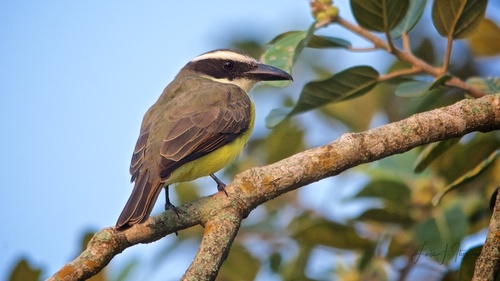
Boat-billed Flycatcher
Megarynchus pitangua
Recognized by its massive, boat-shaped bill and bold facial mask, this charismatic flycatcher is a master of the tropical canopy. A loud and social resident of the Americas, it brings a splash of bright yellow and fierce personality to any backyard forest edge.
Quick Identification
Size
Length of 21–24 cm (8.3–9.4 in); wingspan of 36–40 cm (14–16 in); weight ranges from 63 to 77 g (2.2–2.7 oz).
Colors
Bright yellow underparts; olive-brown upperparts; black head with a bold white supercilium (eyebrow); hidden yellow or orange crown patch.
Key Features
- Exceptionally broad, heavy black bill with a hooked tip
- Bold black-and-white striped head pattern
- Stocky build with a disproportionately large head
- Loud, nasal 'shree-zeee' call
When You’ll See Them
Geographic range
Where Does the Boat-billed Flycatcher Live?
The Boat-billed Flycatcher is native to the Neotropical realm, spanning a massive territory from the coastal lowlands of Mexico through every country in Central America. Its core range extends across the South American continent to northern Argentina and includes the island of Trinidad, thriving in almost every environment except for the high Andes and the aridest deserts.
Basemap © OpenStreetMap contributors
Behavior
The Boat-billed Flycatcher is a boisterous and highly social member of the tyrant flycatcher family. Often seen in pairs or small family groups, these birds are known for their loud, nasal calls that resonate through the canopy. Unlike many smaller flycatchers that remain shy, this species is quite bold and can often be spotted perched prominently on high, exposed branches while surveying its territory for intruders or prey.
They are highly territorial and will aggressively defend their nesting sites against much larger birds, including hawks and caracaras. In suburban environments, they adapt remarkably well to human presence, often frequenting gardens with tall trees and ornamental plants. Their foraging style is a mix of 'sally-gleaning'—darting from a perch to snatch insects off leaves—and occasionally hovering to pluck fruit or dive-bombing small vertebrates like lizards.
EverydayEarth exclusive
Camera Tips
To successfully capture the Boat-billed Flycatcher on a backyard camera, you must think vertically. These birds are canopy specialists and rarely descend to the ground or low shrubs. Mount your camera at a height of 10 to 15 feet, ideally on a tree trunk or a specialized pole, and angle it toward a 'sentinel perch'—a bare, horizontal branch that extends out from the main foliage. This is where they spend most of their time waiting for insects.
While they won't visit standard seed or suet feeders, they are highly attracted to moving water. Installing a high-elevation birdbath or a misting system in the canopy can be a total game-changer for your camera captures. Aim your lens at the water source, ensuring you have a fast trigger speed set, as their bathing and drinking visits are often quick and energetic.
During the fruiting season of trees like wild figs or palms, move your camera to face the ripening fruit clusters. Boat-billed Flycatchers will visit these spots repeatedly throughout the morning. To get the best color definition, try to position the camera so the sun is behind it; this prevents the bird's bright yellow belly from being silhouetted or the white head stripes from being blown out by harsh glare.
Because they are vocal birds, using a camera with a high-quality microphone can help you identify them before they even enter the frame. Their nasal, rattling calls are distinct and often precede their arrival at a perch. If your camera supports 'pre-roll' video recording, enable it to catch the moment they dive off their perch to snatch an insect mid-air.
Similar Species
Species that look similar or are commonly confused with Boat-billed Flycatcher.
Great Kiskadee
The Kiskadee has a much narrower bill and a distinct, three-syllable whistling call.
Social Flycatcher
Much smaller in size with a tiny, delicate bill compared to the massive beak of the Boat-billed.
Streaked Flycatcher
Lacks the solid yellow belly, featuring heavy dark streaking on its underparts instead.
Frequently Asked Questions
Record Boat-billed Flycatcher at your habitat
Connect a camera to start building your own species record — AI identifies every visitor automatically.