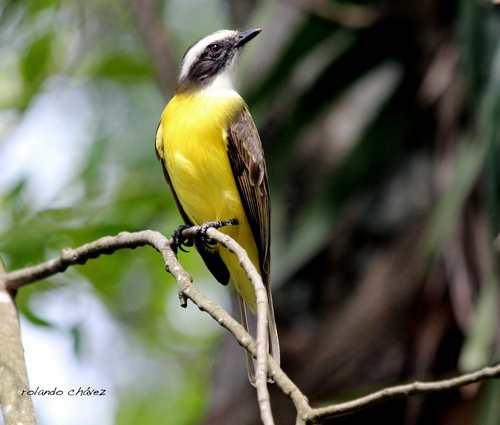
Social Flycatcher
Myiozetetes similis
Meet the Social Flycatcher, the lively and vocal neighbor of the tropical backyard. With its bright yellow belly and unmistakable white 'eyebrow,' this charming bird brings a burst of energy and social flair to any garden scene.
Quick Identification
Size
Length of 16–18 cm (6.3–7.1 inches); wingspan approximately 28–32 cm (11–12.5 inches); weight ranges from 24 to 32 grams (0.8–1.1 ounces).
Colors
Bright yellow belly and underparts contrasted with a clean white throat. The head features a dark mask across the eyes, a prominent white eyebrow (supercilium), and a greyish crown. Upperparts are olive-brown. Males and females are monomorphic, though males possess a hidden orange-red crown patch.
Key Features
- Bright yellow underparts and white throat
- Distinctive white eyebrow stripe above a dark eye mask
- Short, broad black bill
- Social behavior, often seen in pairs or small groups
When You’ll See Them
Sightings on EverydayEarth
Mar 17, 2026
A Whooping Motmot perches prominently on the fruit feeder platform, displaying its vibrant rufous and green plumage and black facial mask. To its right, a Social Flycatcher sits on the edge of the platform. Shortly after, a Clay-colored Thrush flies in and lands on a branch near the red hummingbird feeder. The birds are actively foraging and observing their tropical surroundings.
Jul 27, 2026
Two Giant Cowbirds are seen on the fruit tray, with one actively feeding on the cut bananas and oranges. A Social Flycatcher briefly appears and hops behind the fruit on the left side of the platform.
Jul 23, 2026
Multiple bird species are active at the fruit feeder during a rain shower. A male Thick-billed Euphonia and a Social Flycatcher hop between fruit slices, while a Blue-gray Tanager briefly visits the right side. A Clay-colored Thrush arrives at the end of the clip, perching on the right edge of the tray to begin feeding.
Jul 8, 2026
A diverse group of tropical birds is visiting the feeder simultaneously. A Clay-colored Thrush and a male Crimson-backed Tanager are actively feeding on sliced oranges on the platform. Meanwhile, a Palm Tanager and a Social Flycatcher are perched on the surrounding branches and the feeder's log frame, occasionally moving closer to the food.
Jun 27, 2026
A Palm Tanager is seen perched on the left side of a fruit-covered feeder tray, busily eating pieces of orange. About halfway through the clip, a Social Flycatcher lands on the right side of the platform and begins to inspect the fruit as well.
Jun 23, 2026
A Clay-colored Thrush remains perched on a moss-covered branch on the left, looking toward the camera. Below, a Social Flycatcher lands on the feeder tray to inspect the available fruit slices, while another Social Flycatcher is briefly visible in the background foliage.
Behavior
True to their name, Social Flycatchers are gregarious birds that are rarely found alone. They are highly vocal and active, often seen perched on prominent branches, fence lines, or wires where they can scan the area for insects. Unlike some of their more solitary cousins in the tyrant flycatcher family, these birds enjoy the company of their own kind and are frequently observed in pairs or small family units, often engaging in noisy, synchronized calling displays with shivering wings.
They are bold and adaptable, frequently making themselves at home in gardens, parks, and suburban areas. Their "chips" and "whee" calls are a constant soundtrack in tropical landscapes. While they are primarily insectivores, they are also quite adventurous foragers and have been observed eating berries or even darting toward the water's surface to snatch small tadpoles or tiny fish.
EverydayEarth exclusive
Camera Tips
To capture the best footage of a Social Flycatcher, focus your AI-powered camera on high-traffic perching spots rather than the ground. These birds love "lookout" points—exposed dead branches, fence lines, or even clotheslines—that provide a 360-degree view of their surroundings. Mount your camera at a height of 5 to 10 feet, angling it slightly upward toward these perches. Using a camera with a fast trigger speed or high frame rate is essential, as their sallying flight to catch insects is lightning-fast and can easily be missed by slower sensors.
While they don't typically visit traditional seed feeders, you can lure them into your camera's frame by providing a shallow, elevated birdbath or a moving water feature. Social Flycatchers are drawn to the sound and shimmer of water for both drinking and bathing. Positioning your camera 4-6 feet from a water source with the sun at your back will ensure the vibrant yellow of their bellies remains bright and clear in the recording without being washed out by harsh shadows or backlighting.
If you have fruit-bearing trees like figs or tropical berries in your yard, these are prime locations for camera placement during the fruiting season. Set your camera to take short video bursts (10-15 seconds) rather than just stills to capture their characteristic wing-shivering displays and loud social vocalizations. During the nesting season, look for their bulky, domed nests often built in trees or even on man-made structures; placing a camera at a safe distance can provide a fascinating window into their busy family lives, provided the setup does not disturb their natural behavior.
Similar Species
Species that look similar or are commonly confused with Social Flycatcher.
Great Kiskadee
Much larger body size with a significantly heavier, longer black bill and a louder, three-syllable call.
Rusty-margined Flycatcher
Almost identical in size and color, but features distinct rufous (reddish-brown) edges on its wing feathers.
Boat-billed Flycatcher
Larger with a massive, broad bill that looks 'swollen' compared to the Social Flycatcher's petite beak.
Frequently Asked Questions
Record Social Flycatcher at your habitat
Connect a camera to start building your own species record — AI identifies every visitor automatically.