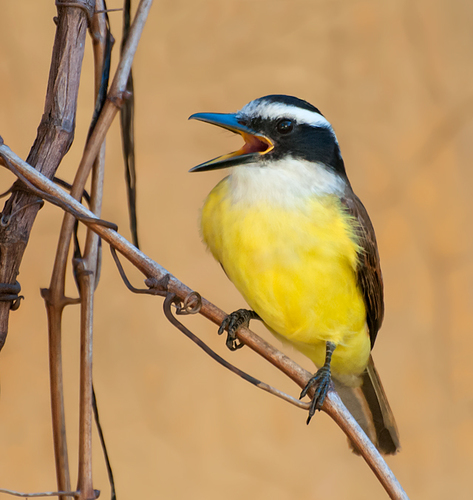
Great Kiskadee
Pitangus sulphuratus
Bold, bright, and incredibly boisterous, the Great Kiskadee is the 'king' of the flycatchers. With its striking yellow belly and unmistakable call, it is a master of the suburban landscape from Texas to Argentina.
Quick Identification
Size
Length: 21–27 cm (8.3–10.6 in); Wingspan: 37–42 cm (14.5–16.5 in); Weight: 53–71 g (1.9–2.5 oz)
Colors
Bright sulfur-yellow belly and chest; rufous-brown back, wings, and tail; striking black-and-white striped head; hidden yellow crown patch visible during displays
Key Features
- Bold black and white striped head mask
- Bright yellow underparts and rufous-toned wings
- Large, heavy black bill with a slight hook
- Loud, three-syllable 'KISS-ka-DEE' vocalization
When You’ll See Them
Geographic range
Where Does the Great Kiskadee Live?
The Great Kiskadee is a quintessential bird of the Americas, with a massive native range extending from the Rio Grande Valley in the extreme southern United States down through Central America to central Argentina. While they are most abundant in the tropical and subtropical heartlands of Brazil and Mexico, they are also thriving residents in South American urban centers. Interestingly, a robust introduced population has existed in Bermuda since the 1950s, where they were originally brought to control lizards but have since become a dominant local species.
Basemap © OpenStreetMap contributors
Behavior
The Great Kiskadee is one of the most charismatic and boisterous members of the tyrant flycatcher family. Known for its fearless personality, this bird is rarely shy around humans and often perches prominently on fences, wires, or exposed branches. They are highly vocal, frequently announcing their presence with the loud, ringing call that gives them their name. Unlike many other flycatchers, they are remarkably social and can often be found in pairs or small family groups, defended by aggressive territorial displays against much larger birds like hawks or caracaras.
These birds are master opportunists. While they are technically flycatchers, their behavior often resembles that of a kingfisher or a jay. It is common to see a Kiskadee dive-bombing into a shallow pond to grab a small fish or tadpole, or scavenging for scraps in a backyard. Their adaptability has allowed them to thrive in human-altered landscapes, making them a common sight in suburban gardens, city parks, and agricultural areas across their range.
EverydayEarth exclusive
Camera Tips
To capture the Great Kiskadee on your backyard camera, focus on their love for water. Unlike many other passerines, Kiskadees frequently hunt in shallow water or use birdbaths for both drinking and vigorous bathing. Place your camera at a low angle (roughly 1 to 2 feet off the ground) facing a wide, shallow birdbath or a garden pond. Ensure the camera is positioned to capture the bird's reflection, as their bright yellow bellies produce stunning visuals against the water.
Because Kiskadees are incredibly fast when they swoop for prey, you should use a high-speed trigger setting or video mode with a high frame rate if your AI camera allows it. They often have 'favorite' perches—usually a specific fence post or an exposed branch—where they sit to scan for insects. If you notice a Kiskadee returning to the same spot, mount your camera facing that perch with the sun at your back to highlight the contrast in their black-and-white head markings.
While they are primarily insectivores, Kiskadees are easily lured by fruit. Offering halved oranges, bananas, or suet during the winter months in the northern parts of their range can bring them directly into your camera's field of view. Set your camera's 'active' zone around a fruit feeder or a platform feeder placed 5-7 feet high, as they prefer to feed at a height that allows for a quick exit if threatened.
Similar Species
Species that look similar or are commonly confused with Great Kiskadee.
Social Flycatcher
Much smaller in size with a smaller, daintier bill and a more complex, trilling song.
Boat-billed Flycatcher
Possesses a much wider, more massive bill and lacks the rufous tones in the wings and tail.
Lesser Kiskadee
Nearly identical plumage but significantly smaller with a thinner bill; found more strictly near water.
Frequently Asked Questions
Record Great Kiskadee at your habitat
Connect a camera to start building your own species record — AI identifies every visitor automatically.