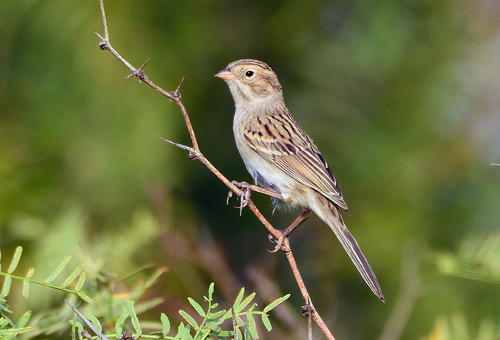
Brewer's Sparrow
Spizella breweri
Meet the master of the sagebrush, a small sparrow with one of the most complex songs in the bird world. Though modest in plumage, the Brewer's Sparrow is a fascinating highlight of the American West's arid landscapes.
Quick Identification
Size
Length: 12-15 cm (4.7-5.9 in); Wingspan: 18-20 cm (7.1-7.9 in); Weight: 8-11 g (0.28-0.39 oz)
Colors
Drab gray-brown upperparts with fine black streaks; unstreaked grayish-white underparts; thin, pale eye-ring; brown crown with fine streaking. Sexes are identical.
Key Features
- Fine dark streaks on a brown crown without a central stripe
- Inconspicuous pale eye-ring and notched tail
- Plain, unstreaked grayish-white breast and belly
- Small, slim profile with a relatively long tail
When You’ll See Them
Geographic range
Where Does the Brewer's Sparrow Live?
Native to the vast landscapes of Western North America, the Brewer's Sparrow is a quintessential bird of the 'Sagebrush Sea.' Its core breeding range stretches across the Great Basin and Intermountain West, covering parts of the western United States and southwestern Canada. As autumn approaches, these hardy little birds migrate southward to spend the winter in the arid regions of the southwestern United States and throughout much of Mexico.
Basemap © OpenStreetMap contributors
Behavior
They are primarily foragers, spending much of their time hopping through the inner branches of sagebrush or on the ground beneath shrubs. While they are generally wary of humans, they can become accustomed to observers if approached quietly. Their interactions with other species are usually peaceful, though they may compete with other sagebrush-dependent birds for nesting sites and food sources during the summer months.
EverydayEarth exclusive
Camera Tips
Capturing the elusive Brewer's Sparrow on camera requires focusing on their preferred 'launch pads'—the outer branches of sagebrush or similar shrubs. Since these birds are low-profile foragers, place your AI-powered camera at a low height, approximately 12 to 24 inches off the ground, angled slightly upward. This positioning is ideal for catching them as they hop between the ground and the lower canopy of a shrub. Because they are small and move quickly, use a high-speed trigger setting or video mode to ensure you don't just get a blur of feathers.
While they don't typically visit traditional bird feeders, you can attract them to your camera's field of view by providing a low-profile water source. A ground-level birdbath or a simple shallow dripping feature is irresistible to these desert-dwelling birds, especially in arid environments. Position the camera about 3-5 feet from the water source to get clear, detailed shots of their delicate facial markings. If you are in a sagebrush area, placing the camera near a particularly dense or tall shrub may catch a male during his morning song ritual.
Timing is everything for this species. Set your camera to be most active during the first three hours after sunrise when males are most vocal and active. During migration in the spring and fall, you might find them in more varied backyard habitats. Using a 'pre-roll' or 'burst' feature on your camera is highly recommended, as Brewer's Sparrows are known for their 'twitchy' movements, often flitting away just as a standard motion sensor would trigger.
Similar Species
Species that look similar or are commonly confused with Brewer's Sparrow.
Frequently Asked Questions
Record Brewer's Sparrow at your habitat
Connect a camera to start building your own species record — AI identifies every visitor automatically.