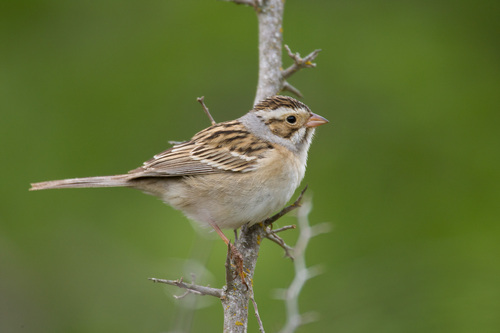
Clay-colored Sparrow
Spizella pallida
A master of camouflage with a distinctive buzzing song, the Clay-colored Sparrow is a delightful visitor to North American shrublands. Discover how to identify this subtle beauty and capture its quick movements on your backyard camera.
Quick Identification
Size
Length 12-14 cm (4.7-5.5 in); Wingspan 18-20 cm (7-8 in); Weight 10-14 g (0.35-0.49 oz)
Colors
Sandy-brown upperparts with dark streaks; unstreaked gray-white underparts; distinct facial pattern with a brown cheek patch bordered by white; crisp gray nape.
Key Features
- Distinctive gray nape (back of neck) contrasting with brown back
- Bold white eyebrow and dark brown ear patch
- Clear, unstreaked pale gray breast
- Small, slender bill and notched tail
When You’ll See Them
Geographic range
Where Does the Clay-colored Sparrow Live?
Native to the vast landscapes of North America, the Clay-colored Sparrow is a long-distance traveler with a range that stretches from the northern Great Plains of Canada and the United States down to the subtropics. During the summer, they are most common across the Canadian Prairies and the northern tier of the U.S. Midwest, while their wintering grounds are concentrated in the arid brushlands of Mexico and Southern Texas. This species is a classic migrant of the central flyway, rarely appearing on the coasts but filling the heartland with its presence every spring.
Basemap © OpenStreetMap contributors
Behavior
Clay-colored Sparrows are energetic little songbirds known for their distinctive, insect-like buzzing songs that ring out across shrubby fields during the spring. They are generally social birds, often found in small flocks during migration and on their wintering grounds, sometimes mixing with other Spizella species like Chipping Sparrows. Despite their subtle plumage, they are quite active, frequently flitting between low perches and the ground while foraging.
During the breeding season, males are conspicuous as they sing from the tops of shrubs to defend their territories. They are not particularly shy around humans, but their small size and camouflaged plumage can make them difficult to spot unless they are vocalizing. In winter, they become more secretive, sticking to dense cover where they search for seeds in the leaf litter or among grasses.
EverydayEarth exclusive
Camera Tips
To capture these small, ground-foraging birds, place your AI camera low to the ground, ideally no more than 1-2 feet high. Aim the lens toward an open patch of dirt or short grass immediately adjacent to a dense shrub or thicket. Clay-colored Sparrows rarely venture far from cover, so they will likely hop out from the bushes to feed and then quickly retreat. If you have a brush pile in your yard, this is a prime location for camera placement.
While they don't typically visit hanging tube feeders as much as other sparrows, they are highly attracted to ground-scattered seeds. Sprinkling a mix of white proso millet and fine cracked corn in front of your camera will significantly increase your chances of a close-up. They are also drawn to water, so a low-profile bird bath or a dripping water feature can serve as an excellent stage for your camera shots, especially during the dry days of migration.
Set your camera to a fast shutter speed or high-sensitivity motion detection, as these birds are quick and jittery. Early morning light is best for highlighting the subtle clay tones and the gray nape that distinguishes them from similar species. In the spring, try to position your camera near a low, sturdy singing perch—like a fence post or the top of a lilac bush—where males might pause to give their buzzing zee-zee-zee call.
Similar Species
Species that look similar or are commonly confused with Clay-colored Sparrow.
Chipping Sparrow
Has a bright rusty cap and a distinct black line running through the eye to the bill.
Brewer's Sparrow
Lacks the distinct gray nape and has a much more finely streaked, uniform brown crown.
Field Sparrow
Easily distinguished by its bright pink bill and a prominent white ring around the eye.
Frequently Asked Questions
Record Clay-colored Sparrow at your habitat
Connect a camera to start building your own species record — AI identifies every visitor automatically.