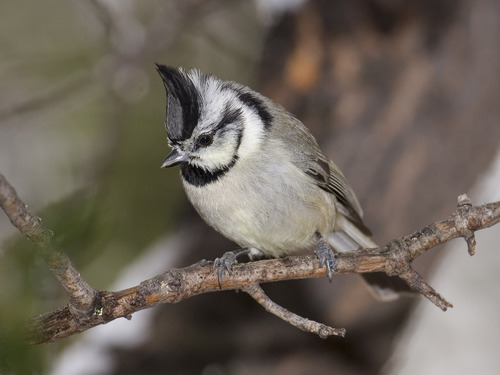
Bridled Titmouse
Baeolophus wollweberi
The Bridled Titmouse is a high-altitude gem of the Southwest, sporting an ornate black-and-white face and a lively, social personality. Whether leading a winter flock or hanging upside down for a snack, this charismatic bird is a favorite for backyard birders and trail cam enthusiasts alike.
Quick Identification
Size
Length: 11.5–13 cm (4.5–5 in); Wingspan: 19 cm (7.5 in); Weight: 8–12 g (0.28–0.42 oz)
Colors
Soft gray upperparts and whitish underparts; distinctive black-and-white facial stripes (the 'bridle'); black throat bib and a gray crest. Sexes are identical.
Key Features
- Striking black and white 'bridled' face pattern
- Small, pointed gray crest
- Tiny, stubby black bill
- Small, acrobatic frame with a black bib
When You’ll See Them
Sightings on EverydayEarth
Jun 15, 2026
A busy scene at the bird sanctuary features several species interacting with the feeding station. An Acorn Woodpecker and a Bridled Titmouse are actively foraging on the wooden structure and suet block. A Bronzed Cowbird perches on a branch to the left, while a Mourning Dove briefly lands on the upper beam before taking flight again.
Geographic range
Where Does the Bridled Titmouse Live?
The Bridled Titmouse is a specialist of the mountain ranges of North America, primarily found in the southwestern United States and Mexico. Its core territory spans the 'Sky Islands' of southeastern Arizona and southwestern New Mexico, extending south through the Sierra Madre Occidental and Sierra Madre Oriental highlands. These birds are dedicated year-round residents of these rugged, wooded regions, rarely moving far from their native oak and pine-oak habitats.
Basemap © OpenStreetMap contributors
Behavior
The Bridled Titmouse is an exceptionally active and social little bird, often found flitting through the canopy of oak woodlands. Unlike many other titmice that become territorial in the winter, this species is highly gregarious and frequently travels in small family groups or mixed-species foraging flocks. They often act as the 'sentinels' of the forest, using their buzzy, scolding calls to alert other birds to the presence of potential predators like hawks or owls.
Incredibly acrobatic, they are known for hanging upside down from the tips of twigs to inspect the underside of leaves for hidden insects. While they are naturally curious and will frequent backyard feeders in the right habitat, they tend to be slightly more skittish than their cousins, the Tufted Titmouse. They are cavity nesters, often utilizing abandoned woodpecker holes or natural hollows in oak trees, sometimes lining their nests with soft materials like animal hair or downy plant fibers.
EverydayEarth exclusive
Camera Tips
To capture the Bridled Titmouse on a backyard camera, placement is everything. These birds are arboreal specialists, so aim your camera at head-height or higher, focusing on oak branches or near an elevated bird feeder. They are particularly attracted to suet and black oil sunflower seeds; a smart bird feeder camera is the most effective way to get the close-up, high-definition shots needed to appreciate their intricate 'bridled' facial markings.
Because they are fast-moving and rarely stay in one spot for more than a second, you must optimize your camera settings. Use a fast trigger speed (under 0.5 seconds) and set your device to capture short, 10-second video clips or a high-speed burst of photos. If your camera allows for sensitivity adjustments, set it to 'High' to ensure it catches these lightweight birds the moment they land on a perch.
During the winter, look for 'mixed-species flocks' consisting of bushtits, kinglets, and warblers. The Bridled Titmouse is often the leader of these groups. If you see one, keep your camera active, as several more are likely to follow. For the best lighting in mountain environments, position the camera facing north or south to avoid the harsh, direct sun that can blow out the white patches on their faces and make identification difficult.
Similar Species
Species that look similar or are commonly confused with Bridled Titmouse.
Juniper Titmouse
Lacks the black-and-white 'bridle' facial pattern and the black throat bib; overall much plainer and grayer.
Oak Titmouse
Found further west in California; lacks the facial striping and is a uniform brownish-gray.
Mountain Chickadee
Has a similar black-and-white head pattern but lacks a crest and has a distinct white stripe above the eye.
Frequently Asked Questions
Record Bridled Titmouse at your habitat
Connect a camera to start building your own species record — AI identifies every visitor automatically.