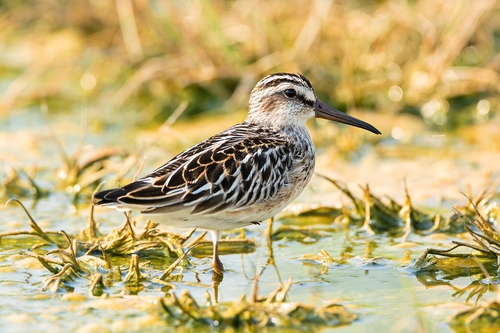
Broad-billed Sandpiper
Calidris falcinellus
A master of the long-haul flight, the Broad-billed Sandpiper is easily identified by its unique 'kinked' bill and striking double-striped crown. This petite wanderer bridges the gap between the frozen Arctic tundra and the tropical sun-soaked mudflats of the south.
Quick Identification
Size
Length: 16–18 cm (6.3–7.1 in); Wingspan: 34–37 cm (13.4–14.6 in); Weight: 25–55 g (0.9–1.9 oz)
Colors
Mottled dark brown and grey upperparts with white 'V' stripes; white underparts with dark streaking on the breast; blackish bill; dark olive or grey legs
Key Features
- Broad, flat bill with a distinct downward kink at the tip
- Double-striped crown with a 'split' white eyebrow (supercilium)
- Short-legged, stocky silhouette compared to other sandpipers
- Dark mantle with prominent pale cream-colored stripes
When You’ll See Them
Geographic range
Where Does the Broad-billed Sandpiper Live?
Native to the northern reaches of the Eastern Hemisphere, the Broad-billed Sandpiper begins its life in the subarctic bogs of Scandinavia and across the vast Siberian tundra of Russia. This species is an extraordinary long-distance migrant, traveling south to winter along the warm coastal fringes of East Africa, the Arabian Peninsula, India, Southeast Asia, and as far south as Australia. While it is rarely seen in the Americas, it is a staple of the East Atlantic, West Asian, and East Asian-Australasian flyways, making it a prized sighting for coastal birdwatchers across these regions.
Basemap © OpenStreetMap contributors
Behavior
The Broad-billed Sandpiper is a fascinating, somewhat understated wading bird known for its calm and approachable nature. Unlike some of its more skittish cousins, this species is often described as 'tame,' allowing observers to get relatively close before taking flight. They are highly migratory, traveling vast distances between their Arctic breeding grounds and their tropical wintering sites. During the breeding season, they are somewhat solitary or form small colonies, but they become much more social during migration and winter, often joining mixed-species flocks of other small shorebirds like Dunlins or Red-necked Stints.
When foraging, these birds exhibit a distinctive hunched posture, moving slowly across the mud with their heads down. They use a rhythmic 'stitching' motion with their bills to probe the soft substrate for food. They are most active around the tidal cycle in coastal areas, moving to higher ground or inland lagoons when the tide comes in. Despite their small size, they are incredibly hardy, navigating some of the world's most demanding migratory flyways twice a year.
EverydayEarth exclusive
Camera Tips
Capturing the Broad-billed Sandpiper on camera requires a strategy focused on the mud. Because these birds are low-slung and feed with their heads down, your camera should be mounted as low to the ground as possible—ideally just a few inches above the mud line. A 'ground pod' or a low-profile stake mount is essential for that intimate, eye-level perspective that makes shorebird photography stand out. Position your camera near the edge of a receding tide line or by the margins of a shallow salt marsh pool where the mud is soft and moist.
Since these birds are smaller than a robin, trigger sensitivity is crucial. Set your AI-powered camera to its highest sensitivity or use a 'small animal' detection mode if available. Because they are often active in the bright, reflective environments of coastal mudflats, you may need to adjust your exposure compensation slightly downward to avoid blowing out the white highlights on their bellies. Fast shutter speeds are a must to freeze the motion of their rapid probing bill movements.
Timing is everything with this species. Use a tide chart to plan your camera placement; the two hours before and after low tide are peak foraging times. If you are in a backyard setting near a wetland, creating a 'soft' shoreline with shallow water and exposed mud can lure them in. Unlike many birds, they aren't attracted to traditional feeders, but they are attracted to healthy, pesticide-free mud rich in natural invertebrates. High-quality waterproof housing is non-negotiable, as salt spray and tidal mud can be punishing on equipment.
Similar Species
Species that look similar or are commonly confused with Broad-billed Sandpiper.
Dunlin
Dunlins are slightly larger with a more uniform downward curve to the bill and lack the 'split' eyebrow of the Broad-billed.
Curlew Sandpiper
Has much longer legs and a more dramatically curved, longer bill compared to the stocky Broad-billed.
Sanderling
Much paler in non-breeding plumage and typically found running on sandy beaches rather than muddy estuaries.
Frequently Asked Questions
Record Broad-billed Sandpiper at your habitat
Connect a camera to start building your own species record — AI identifies every visitor automatically.