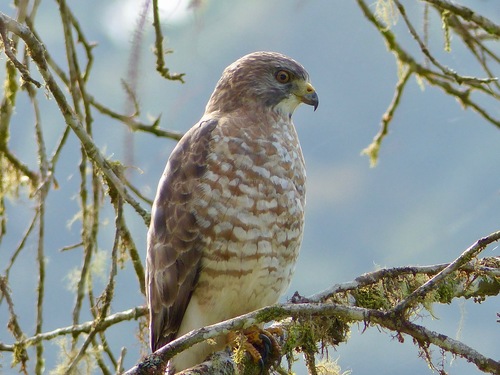
Broad-winged Hawk
Buteo platypterus
The Broad-winged Hawk is the 'quiet neighbor' of the forest, a small but powerful hunter known for its spectacular long-distance migrations and distinctive banded tail.
Quick Identification
Size
Length: 34–45 cm (13.4–17.7 in); Wingspan: 81–100 cm (32–39.4 in); Weight: 265–560 g (9.3–19.8 oz)
Colors
Light morphs have dark brown upperparts and white underparts with reddish-brown horizontal barring. The tail is distinctive with bold, equal-width black and white bands. Dark morphs are entirely soot-brown.
Key Features
- Relatively short, broad wings with pointed tips
- Tail features 2-3 thick, equal-width white and black bands
- High-pitched, piercing 'kee-ee' whistle call
- Smallest of the common North American Buteo hawks
- Black trailing edge along the underwing
When You’ll See Them
Geographic range
Where Does the Broad-winged Hawk Live?
Broad-winged Hawks are native to the Americas, breeding across a vast region of eastern North America from the Gulf Coast up into the Canadian boreal forests and west to the edge of the Great Plains. As winter approaches, almost the entire population migrates thousands of miles to the tropical regions of Central America and northern South America. Some specialized subspecies are year-round residents on specific Caribbean islands, but the majority are true long-distance travelers that rely on continuous forest corridors for their annual journeys.
Basemap © OpenStreetMap contributors
Behavior
Broad-winged Hawks are masters of the forest interior, spending much of their time perched on low-hanging branches in the canopy. Unlike their more conspicuous cousins that soar over open fields, these hawks prefer to stay hidden, watching the ground for movement from a stationary position. They are sit-and-wait predators, often described as having a 'tame' or approachable demeanor compared to other raptors, though they are fierce defenders of their nests during the breeding season.
During the spring and summer, they are solitary or pair-bound, but they undergo a dramatic behavioral shift during the autumn migration. They are famous for forming 'kettles'—massive swirling groups of hundreds or even thousands of hawks—as they ride thermals together on their journey south. In backyard settings, they are most often seen briefly as they swoop down to grab a snack or visit a water source before returning to the safety of the dense trees.
EverydayEarth exclusive
Camera Tips
To capture a Broad-winged Hawk on a backyard or trail camera, focus your efforts on 'perch-and-pounce' locations. These hawks love horizontal branches about 10 to 15 feet off the ground that overlook a small clearing or a forest edge. Mounting your camera about 5-7 feet high on an opposite tree and angling it slightly upward toward the perch can provide a dramatic, eye-level look at their intricate plumage. Because they are forest-dwellers, dappled light can be tricky, so try to position the camera with the sun at your back to avoid silhouetting the bird.
Water is a major draw for this species, especially in late summer and during migration. A large, shallow ground-level birdbath or a natural-looking stone basin placed in a quiet, shaded area of your yard is highly effective. Position your camera about 8-12 feet from the water source. Broad-winged Hawks are known to spend several minutes bathing and preening, providing excellent opportunities for high-quality footage. Avoid using birdseed, as they aren't seed-eaters, but a yard that supports healthy populations of frogs or snakes will naturally attract them.
For camera settings, prioritize a fast trigger speed and high-frame-rate video. Because Broad-winged Hawks often sit motionless for long periods before a sudden dive, use a 'Video' or 'Hybrid' mode with a 20-second clip duration. This ensures you catch the take-off and landing rather than just a still shot of an empty branch. If your camera allows for sensitivity adjustments, set it to 'High' to detect the bird even if it is sitting still on a branch. During the peak of migration in September, leave your cameras running continuously, as you might catch a rare dark-morph individual passing through.
Similar Species
Species that look similar or are commonly confused with Broad-winged Hawk.
Red-shouldered Hawk
Larger with many thin white tail bands and a more colorful, checkered wing pattern.
Cooper's Hawk
Longer, rounded tail and a sleeker build; lacks the broad, 'chunkier' wings of the Buteo family.
Red-tailed Hawk
Significantly larger with a heavy build and a distinct reddish tail (in adults) without the broad black bands.
Frequently Asked Questions
Record Broad-winged Hawk at your habitat
Connect a camera to start building your own species record — AI identifies every visitor automatically.