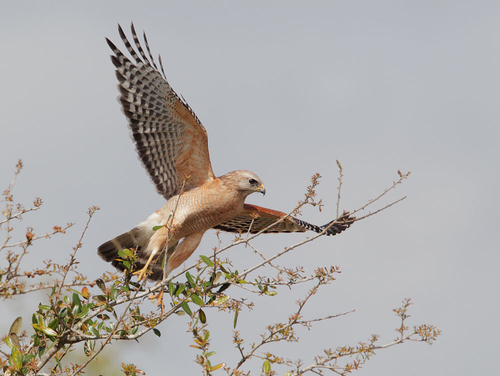
Red-shouldered Hawk
Buteo lineatus
Vibrant and vocal, the Red-shouldered Hawk is the stunning 'woodland whistler' of the raptors. Recognizable by their fiery plumage and checkered wings, these hawks bring a touch of wild elegance to wooded suburbs and wetlands alike.
Quick Identification
Size
Length: 17-24 in (43-61 cm); Wingspan: 37-43 in (94-110 cm); Weight: 1.1-1.7 lbs (486-774 g)
Colors
Adults feature warm reddish-orange 'shoulders' and barred underparts; wings are distinctively checkered black and white; tail is dark with narrow white bands.
Key Features
- Vivid reddish-orange barring on chest and shoulders
- Checkered black-and-white wing pattern
- Translucent 'crescents' near the wingtips visible in flight
- Dark tail with multiple narrow white bands
When You’ll See Them
Behavior
Red-shouldered Hawks are among the most vocal raptors you’ll encounter, often heard long before they are seen. Their distinctive, screaming 'kee-aah' call is a hallmark of the forest edge and is frequently mimicked by Blue Jays. Unlike some of their larger cousins who soar for hours in the open sky, these hawks are sit-and-wait predators, preferring to scan the ground from a low-hanging branch or a telephone wire.
They are highly territorial and remarkably loyal to their nesting sites, often returning to the same patch of woods for many years. In suburban environments, they have become quite comfortable around humans, often hunting in backyards that offer a mix of open grass and mature trees. While they are bold defenders of their nests, they generally maintain a calm, watchful presence during the day, moving between several favorite perches within their home range.
EverydayEarth exclusive
Camera Tips
To capture high-quality footage of a Red-shouldered Hawk, focus your camera placement on 'transitional zones'—where your lawn meets thicker wooded areas or near the edge of a backyard pond. These hawks are 'perch hunters,' meaning they spend hours sitting on branches 10 to 20 feet off the ground. Position your camera on a fence post or a lower tree trunk at about 5-7 feet high, facing a clear patch of ground or a known hunting perch. If you notice a hawk frequently using a specific branch or utility pole, angle your camera to capture the space just below it where they are likely to strike.
Water is the absolute best natural lure for this species. Red-shouldered Hawks are surprisingly fond of bathing, more so than many other large raptors. If you have a large, sturdy bird bath or a shallow garden pond, aim your camera there. Use a fast trigger speed or 'Burst Mode' to catch the action, as their visits to the water are often punctuated by dramatic wing-splashing and vigorous shaking. Early morning light provides the best color rendition for their fiery orange breast feathers.
During the winter months, these hawks are often easier to photograph because the lack of foliage provides a clearer line of sight for your camera’s motion sensor. If you’re using a trail camera, set the sensitivity to high, as birds can sometimes move too quickly for standard settings. Avoid the temptation to use meat as bait, which can attract unwanted scavengers or habituate the hawk to humans; instead, maintain a 'wild' corner of your yard with tall grass or a brush pile. This attracts the frogs and mice that serve as a natural food source, turning your yard into a reliable hunting ground for the hawks.
Similar Species
Species that look similar or are commonly confused with Red-shouldered Hawk.
Red-tailed Hawk
Larger with a signature cinnamon-red tail; lacks the checkered wing pattern and has a pale chest with a dark 'belly band'.
Cooper's Hawk
Smaller with a much longer, rounded tail; has a more 'flap-flap-glide' flight pattern and lacks the white wing crescents.
Broad-winged Hawk
Smaller with a much thicker white band on the tail; they are typically only seen in North America during the summer breeding season.
Frequently Asked Questions
Record Red-shouldered Hawk at your habitat
Connect a camera to start building your own species record — AI identifies every visitor automatically.