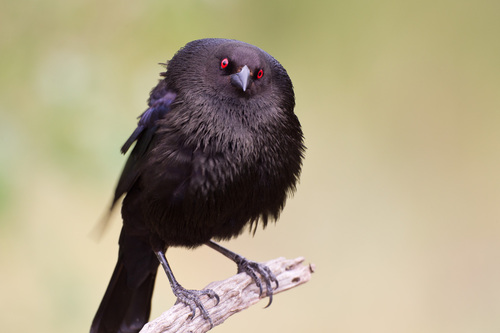
Bronzed Cowbird
Molothrus aeneus
Featuring shimmering iridescent plumage and piercing red eyes, the Bronzed Cowbird is a master of the 'look-but-don't-touch' approach to parenting. This bold socialite is a common sight across the Southern US and Mexico, known for its dramatic courtship dances and clever survival tactics.
Quick Identification
Size
Length: 20 cm (8 in); Wingspan: 33-37 cm (13-14.5 in); Weight: 55-75 g (1.9-2.6 oz)
Colors
Adult males are glossy black with a bronze-green sheen and distinctive bright red eyes. Females are a duller, matte grayish-brown or charcoal with darker eyes.
Key Features
- Striking red eyes in adult males
- Thick-based, conical bill
- Erectile neck ruff or hackles during displays
- Short, square-tipped tail
When You’ll See Them
Sightings on EverydayEarth
Jun 15, 2026
A busy scene at the bird sanctuary features several species interacting with the feeding station. An Acorn Woodpecker and a Bridled Titmouse are actively foraging on the wooden structure and suet block. A Bronzed Cowbird perches on a branch to the left, while a Mourning Dove briefly lands on the upper beam before taking flight again.
May 13, 2026
A small group of Bronzed Cowbirds has gathered at a rocky desert water feature. An iridescent black male with striking red eyes perches on the upper-left rim, watching the surroundings while several brownish females drink and hop along the water's edge.
May 12, 2026
A group of White-winged Doves has gathered at a rocky water basin. One individual is in the center of the pool, vigorously bathing and spreading its wings to reveal bold white stripes. Other doves perch on nearby branches and the stone rim. A Bronzed Cowbird enters from the left and walks toward the water, while a Mexican Jay quickly flies across the upper part of the scene.
Geographic range
Where Does the Bronzed Cowbird Live?
Native to the Americas, the Bronzed Cowbird thrives across a wide swath of territory from the southern United States through Central America. Its core range spans the entirety of Mexico and down into Panama, while in the U.S., it is most frequently encountered in the border states of Texas, Arizona, New Mexico, and southern California. As human development creates more of the open, fragmented landscapes they prefer, these birds are steadily expanding their range further north into the American Southwest and Gulf Coast regions.
Basemap © OpenStreetMap contributors
Behavior
The Bronzed Cowbird is a fascinating and highly social species, though often viewed with caution by bird enthusiasts due to its status as a brood parasite. Unlike most birds, they do not build their own nests; instead, females stealthily lay their eggs in the nests of other species—most commonly orioles and towhees—leaving the host parents to raise the cowbird chicks. This strategy allows them to spend more time foraging and engaging in complex social interactions.
In the backyard, you will often see them in small groups or mixed flocks with other blackbirds. They have a very distinctive courtship display where the male puffs out his neck feathers into a prominent ruff, hovers a few feet in the air, and then bows deeply while emitting a mechanical, wheezy song. While they are wary of humans, they are easily drawn to areas with livestock or bird feeders where food is abundant.
EverydayEarth exclusive
Camera Tips
To capture the best footage of Bronzed Cowbirds, ground-level placement is key. These birds are primarily terrestrial foragers, so positioning your camera 6 to 12 inches off the ground near a patch of bare earth or short grass will yield the most intimate shots. If you have a backyard bird bath, aim the camera there; their social bathing habits often lead to high-energy videos with multiple birds interacting at once.
For the best visual results, try to position your camera with the sun at its back. The "bronze" in their name comes from an iridescent sheen on the male's feathers that only pops under direct, bright light. In shadows, they look like simple black birds, but in the morning sun, the camera will pick up the shimmering metallic greens and bronzes that make this species unique. High-resolution settings are a must to capture the fine detail of the male's striking red iris.
If you are looking to record their unique "hover-and-bow" courtship display, set your camera near a popular feeding station during the spring months. Use a high frame rate (60fps if available) because their displays involve rapid wing movements and sudden puffing of the neck ruff. Scattered cracked corn or white proso millet on the ground is the most effective way to keep them in the camera's frame for an extended period.
Similar Species
Species that look similar or are commonly confused with Bronzed Cowbird.
Brown-headed Cowbird
Smaller with a brown head and dark eyes; lacks the thick neck ruff and red iris of the Bronzed Cowbird.
Shiny Cowbird
Has a more slender bill and uniform purple-blue iridescence rather than the bronze-green sheen; eyes are always dark.
Great-tailed Grackle
Much larger with a significantly longer, keel-shaped tail and yellow eyes rather than red.
Frequently Asked Questions
Record Bronzed Cowbird at your habitat
Connect a camera to start building your own species record — AI identifies every visitor automatically.