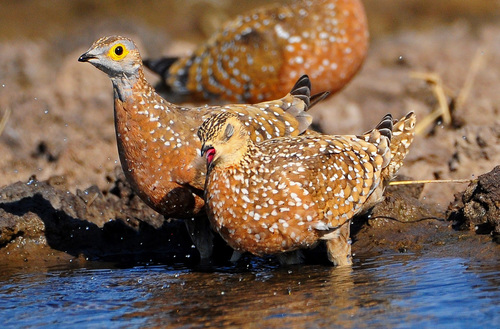
Burchell's Sandgrouse
Pterocles burchelli
A master of desert camouflage, Burchell's Sandgrouse is a white-spotted beauty famous for its incredible morning flights and its unique ability to carry water in its feathers.
Quick Identification
Size
Length: 25–28 cm (10–11 in); Weight: 160–200 g (5.6–7 oz)
Colors
Cinnamon-buff overall with a dense pattern of small white spots (ocelli); males have a yellowish-ochre face and throat while females are more uniformly mottled.
Key Features
- Dense white 'polka dot' pattern across entire body
- Short, feathered legs adapted for sandy ground
- Small, pigeon-like head and short tail
- Cinnamon-brown base plumage providing desert camouflage
When You’ll See Them
Geographic range
Where Does the Burchell's Sandgrouse Live?
Burchell's Sandgrouse is a quintessential specialist of the Southern African interior. Its range is centered heavily on the Kalahari Basin, with the highest population densities found throughout Botswana and eastern Namibia. The species also extends into the northern reaches of South Africa, particularly the Northern Cape and North West provinces, as well as southwestern Zimbabwe and southern Angola. Because they are nomadic, their local presence often shifts depending on recent rainfall and the availability of surface water.
Basemap © OpenStreetMap contributors
Behavior
Burchell's Sandgrouse is a highly social bird, typically seen in pairs or small family groups that occasionally merge into larger flocks of dozens at watering holes. They are ground-dwellers by nature, relying on their incredible camouflage to vanish against the red sands of the Kalahari. When threatened, they prefer to crouch low and remain motionless rather than fly, only taking to the air at the last possible second with a distinctive, soft 'chup-chup' call.
Perhaps their most famous behavior is their morning drinking ritual. Every day, usually between two and three hours after sunrise, these birds fly significant distances to reach permanent or semi-permanent water sources. Males have specialized belly feathers that act like a sponge, allowing them to soak up water and carry it back over many miles to provide moisture for their chicks in the nest.
EverydayEarth exclusive
Camera Tips
To capture Burchell's Sandgrouse, your best bet is to position your camera near a known water source or a shallow depression where water collects after a rain. These birds are creatures of habit and will visit the same watering spots between 8:00 AM and 10:00 AM almost every morning. Place the camera at a very low angle—no more than 10-15 cm off the ground—to get an eye-level view of them drinking and interacting.
Because they often arrive in groups and move quickly while drinking, use a fast shutter speed or a 'burst' photo mode to avoid motion blur. If your camera supports high-definition video, this is the best way to capture the fascinating 'belly-soaking' behavior of the males. Look for them wading slightly deeper than the females to saturate their chest feathers.
In a backyard or farm setting in Southern Africa, providing a shallow, ground-level birdbath in a sandy area can act as a powerful lure. Avoid placing the camera near tall grass or thick bushes where predators might hide, as sandgrouse are extremely wary of cover and prefer open, clear sightlines while they are on the ground. Mid-morning light provides the best illumination for their intricate spotted patterns.
Similar Species
Species that look similar or are commonly confused with Burchell's Sandgrouse.
Namaqua Sandgrouse
Namaqua sandgrouse have long, pointed tails and males lack the 'polka dot' spotting, featuring a clear double breast band instead.
Double-banded Sandgrouse
Prefer darker, more wooded habitats and are mostly active at dusk; they have bold black-and-white forehead markings.
Yellow-throated Sandgrouse
Larger with a more uniform yellowish plumage and lacking the dense white spotting found on the Burchell's.
Frequently Asked Questions
Record Burchell's Sandgrouse at your habitat
Connect a camera to start building your own species record — AI identifies every visitor automatically.