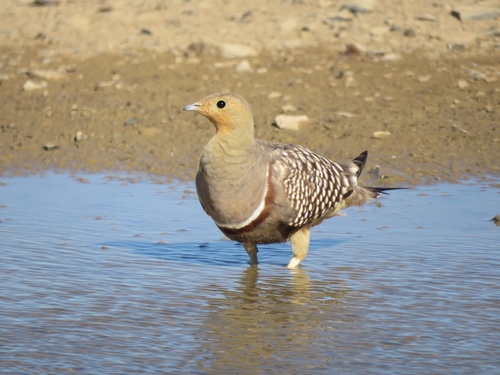
Namaqua Sandgrouse
Pterocles namaqua
The Namaqua Sandgrouse is a master of desert survival, known for its incredible ability to carry water in its feathers to thirsty chicks miles away. This beautifully camouflaged bird is a highlight for any desert wildlife discovery.
Quick Identification
Size
24–28 cm (9.5–11 in) in length; weighs between 170–240 g (6–8.5 oz)
Colors
Cryptic yellowish-brown and buff; males have a distinct white and maroon breast band; females are more heavily mottled and barred
Key Features
- Elongated, pointed central tail feathers
- Double breast band in males (white and chocolate brown)
- Pigeon-like head with large, dark eyes
- Cryptic, sandy plumage for desert camouflage
When You’ll See Them
Geographic range
Where Does the Namaqua Sandgrouse Live?
Native to the sun-drenched landscapes of Southern Africa, the Namaqua Sandgrouse is a true specialist of the desert. Its core range spans the vast, arid reaches of Namibia and the Northern Cape of South Africa, extending into the dry Kalahari regions of southern Botswana and southwestern Angola. In these harsh environments, the species thrives where few others can, moving nomadically across gravel plains and scrubby karoo as rainfall and food availability shift.
Basemap © OpenStreetMap contributors
Behavior
The Namaqua Sandgrouse is a highly social bird, often seen in small groups during the day and massive flocks of hundreds at watering holes. They are renowned for their incredible desert survival strategy: the males possess specialized belly feathers that can soak up and retain water like a sponge. After wading into a water source, the male flies back to the nest—sometimes over distances of 30 kilometers—to allow his chicks to drink from his soaked plumage.
These birds are primarily ground-dwellers, spending most of their time walking across gravel plains or sandy soil in search of food. They are incredibly wary of predators and rely on their remarkable camouflage to disappear into the landscape. When they do take flight, they are fast and direct, often emitting a characteristic 'kelkiewyn' call that is a signature sound of the southern African arid zones.
EverydayEarth exclusive
Camera Tips
To capture the best footage of Namaqua Sandgrouse, your primary target should be a water source. These birds are famous for their synchronized drinking rituals, typically arriving at waterholes between 8:00 AM and 10:00 AM. Position your camera at ground level, roughly 2 to 3 meters from the water’s edge, ensuring it is well-camouflaged or placed within a small depression. Because they often land a short distance away and walk to the water, a wide-angle lens can capture the approach, while a more focused lens is better for the iconic drinking behavior.
Lighting is crucial in desert environments. Aim to have the sun behind your camera to illuminate the subtle, intricate patterns of their plumage. If you are using an AI-triggered camera, set the sensitivity to high, as their sandy coloration can blend in perfectly with the background. For the most dramatic shots, try to capture the males as they wade into the water to soak their specialized belly feathers—this unique behavior is a gold-standard capture for any wildlife enthusiast.
In backyard settings on the edge of arid towns, providing a shallow, ground-level birdbath can be a magnet for this species. Unlike typical songbirds, sandgrouse prefer open areas with clear lines of sight to watch for predators. Keep the area around your camera clear of tall grass or dense bushes. During the dry winter months, these visits will become much more frequent and predictable, offering the best chance for high-quality photos and videos.
Similar Species
Species that look similar or are commonly confused with Namaqua Sandgrouse.
Frequently Asked Questions
Record Namaqua Sandgrouse at your habitat
Connect a camera to start building your own species record — AI identifies every visitor automatically.