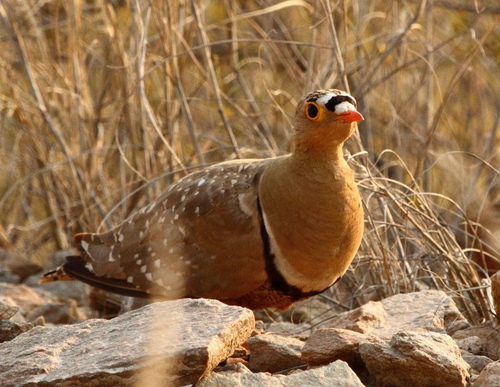
Double-banded Sandgrouse
Pterocles bicinctus
A master of desert camouflage, the Double-banded Sandgrouse is famous for its sunset pilgrimages to waterholes and its remarkable ability to carry water in its feathers.
Quick Identification
Size
Length: 25–28 cm (10–11 in); Wingspan: 45–52 cm (18–20.5 in); Weight: 150–260 g (5.3–9.2 oz)
Colors
Males have a black and white forehead band and a yellow eye-ring; both sexes feature cryptic mottled brown, buff, and grey plumage with fine barring.
Key Features
- Distinctive black and white 'double band' on the male's forehead
- Yellow orbital ring and bright yellow base of the bill
- Plump, pigeon-like body with short legs and a small head
- Intricate white-spotted wing coverts
When You’ll See Them
Geographic range
Where Does the Double-banded Sandgrouse Live?
The Double-banded Sandgrouse is a signature species of the Southern African landscape. It is most commonly found across the arid regions of Namibia and Botswana, extending its reach into southern Angola, Zambia, and Zimbabwe. Visitors to northern South Africa and the drier western fringes of Mozambique are also likely to encounter this well-camouflaged ground-dweller in its native savanna and scrubland habitats.
Basemap © OpenStreetMap contributors
Recorded on EverydayEarth
Behavior
The Double-banded Sandgrouse is a terrestrial specialist, spending the vast majority of its time walking on the ground in search of food. They are most famous for their highly predictable social rituals; while they forage in pairs or small family groups during the day, they congregate in large, chatter-filled flocks at waterholes during the twilight hours. This crepuscular schedule helps them avoid the worst of the African heat and many daytime predators.
These birds have a remarkable physiological adaptation for parenting. To provide water for their chicks, which remain in the nest on the dry ground, the males have specialized absorbent feathers on their bellies. After drinking at a waterhole, the male will soak his breast feathers and fly back to the nest, allowing the chicks to 'milk' the water from his plumage. This incredible feat of endurance and biology allows them to raise young in some of the most arid environments on Earth.
EverydayEarth exclusive
Camera Tips
Capturing a Double-banded Sandgrouse on a backyard or trail camera requires a strategy focused on water. Because these birds have a strict schedule for drinking, usually arriving at water sources just after sunset or just before sunrise, your camera's low-light performance is critical. Position your camera at a very low angle—no more than 6 inches off the ground—facing a shallow water basin or a natural puddle. This low-profile placement allows the AI to capture the diagnostic head markings and the intricate patterns of their feathers as they approach the water on foot.
Since sandgrouse are wary and easily spooked by movement, use a camera with a 'no-glow' or invisible infrared flash to avoid startling the flock at dusk. They often land 10 to 20 feet away from the water and walk the rest of the distance, so a wide-angle lens or a camera with a wide field of view is ideal to capture the group's social interactions. If you are using a bait-based lure, small grass seeds or wild bird mix scattered near the water can encourage them to linger longer in front of the lens.
Settings-wise, prioritize a fast trigger speed. Even though they are ground birds, they move with a quick, nervous pecking motion and can take flight instantly if disturbed. In arid environments, the heat can cause false triggers, so placing your camera in a shaded spot or using a 'High' sensitivity setting specifically during the dawn and dusk hours will yield the best results. During the dry season (winter months), their visits will be more frequent and predictable, making this the best time for high-quality captures.
Similar Species
Species that look similar or are commonly confused with Double-banded Sandgrouse.
Namaqua Sandgrouse
Has a long, pointed 'pin-tail' and the male has a white and maroon band across the breast rather than the forehead.
Burchell's Sandgrouse
Lacks the forehead bands and features a more heavily spotted 'salt-and-pepper' appearance across the entire body.
Yellow-throated Sandgrouse
Noticeably larger with a distinct yellow throat patch and a black line separating the neck from the breast in males.
Frequently Asked Questions
Record Double-banded Sandgrouse at your habitat
Connect a camera to start building your own species record — AI identifies every visitor automatically.