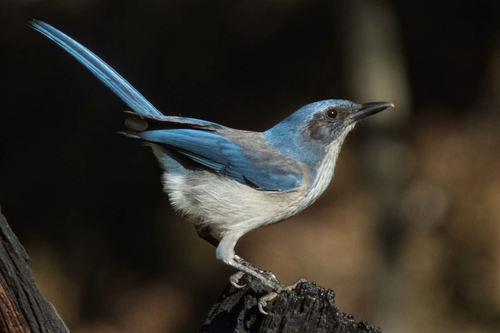
Woodhouse's Scrub-Jay
Aphelocoma woodhouseii
A clever and understated beauty of the Interior West, the Woodhouse's Scrub-Jay brings a flash of azure and a sharp wit to any backyard. Watch as these intelligent corvids outsmart squirrels and meticulously hide treasures for the winter.
Quick Identification
Size
Length: 27-30 cm (10.6-11.8 in); Wingspan: 39 cm (15 in); Weight: 74-100 g (2.6-3.5 oz)
Colors
Soft azure-blue head, wings, and tail; brownish-gray back; grayish-white underparts with a faint, streaky blue breast band. Males and females look identical.
Key Features
- Slender, straight black bill
- Dull blue upperparts with a distinct gray-brown back patch
- Faint, streaky blue-gray 'necklace' or breast band
- Lacks a crest on the head
When You’ll See Them
Behavior
Woodhouse’s Scrub-Jays are highly intelligent and social members of the crow family. Unlike their more boisterous California cousins, they tend to be a bit more reserved, though they are still quite bold around backyard feeders. They are famous for their 'caching' behavior, where they hide thousands of seeds and nuts each year to retrieve later, displaying a remarkable memory for locations. This behavior actually helps forest regeneration, as many of the nuts they forget to dig up eventually grow into trees.
These birds live in stable pairs or small family groups and are known to be quite vocal, using a variety of raspy, dry screeches to communicate or warn of predators. In suburban settings, they can become quite tame, often recognizing individual humans who provide food and even waiting near windows or doors for a handout. They are observant and will often watch where other birds hide food so they can steal it later.
EverydayEarth exclusive
Camera Tips
To capture the best footage of a Woodhouse's Scrub-Jay, position your AI-powered camera near a platform feeder or a flat, elevated surface like a fence rail or a stone wall. Because these birds are ground-foragers and natural 'cachers,' placing a camera about 3 to 5 feet off the ground, angled slightly downward toward a landing spot, works best. They are particularly attracted to whole, in-shell peanuts; if you want high-quality 'action' shots, try wedging a few peanuts into the bark of a tree or a small crack in a log. This forces the jay to work to extract the prize, giving your camera more time to trigger and record their problem-solving behavior.
Lighting is crucial for bringing out the subtle blue tones of their plumage, which can look muddy or gray in deep shade. Aim your camera to face North or South to avoid direct lens flare, and try to catch the 'golden hour' light in the early morning or late afternoon when they are most active. Since they are wary of sudden movements, ensure your camera is well-mounted and doesn't wobble. Using a 'fast trigger' or 'burst mode' setting is highly recommended, as these birds move in quick, jerky motions when landing and scanning for danger.
Consider the seasonal context of your setup. In the autumn, Woodhouse's Scrub-Jays are in a frenzy of caching. This is the best time to set up your camera near a patch of loose soil or a woodpile, as they will frequently land to bury nuts. In the heat of summer, a birdbath is an even better lure than food. Set the camera at eye-level with the water's surface to capture spectacular splashing and preening shots. Make sure the water is shallow—about 1 to 2 inches—to make them feel secure enough to land and linger.
Similar Species
Species that look similar or are commonly confused with Woodhouse's Scrub-Jay.
California Scrub-Jay
Features much brighter blue plumage and a bold, well-defined dark blue breast band.
Blue Jay
Has a prominent head crest and white spotting on the wings and tail, which the Woodhouse's lacks.
Pinyon Jay
A more uniform dull blue overall with a shorter tail, usually seen in much larger, noisier flocks.
Frequently Asked Questions
Record Woodhouse's Scrub-Jay at your habitat
Connect a camera to start building your own species record — AI identifies every visitor automatically.