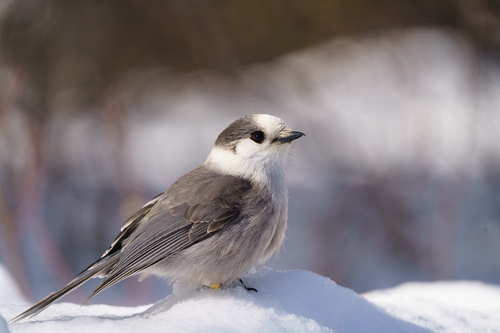
Canada Jay
Perisoreus canadensis
Meet the bold 'Whisky Jack' of the boreal forest. Known for its incredible intelligence and friendly nature, the Canada Jay is the fearless phantom of the north woods.
Quick Identification
Size
Length: 25-33 cm (10-13 in); Wingspan: 45 cm (18 in); Weight: 65-75 g (2.3-2.6 oz)
Colors
Soft medium-grey upperparts with pale grey to white underparts; white face with a distinctive dark grey to black nape or 'cap'. No visible difference between males and females.
Key Features
- Dark grey nape and white forehead
- Short, stout black bill
- Fluffy, thick plumage for cold insulation
- Long, rounded tail
- Bold, gliding flight pattern
When You’ll See Them
Geographic range
Where Does the Canada Jay Live?
The Canada Jay is a native icon of the North American wilderness, spanning the vast boreal forests from Alaska across all of Canada to the Atlantic coast. In the United States, their range extends southward through the high-elevation subalpine zones of the Rocky Mountains into New Mexico and Arizona, as well as the Cascades and northern New England forests. They are strictly permanent residents of these northern and mountainous regions, rarely wandering far from their established territories even in the harshest winters.
Basemap © OpenStreetMap contributors
Behavior
The Canada Jay is renowned for its remarkable intelligence and fearlessness. Unlike many songbirds that flee at the sight of humans, these 'Whisky Jacks' often glide down from the canopy to investigate hikers, campers, and backyard observers. They are highly social and usually travel in small family groups consisting of a mated pair and sometimes a 'third wheel' juvenile from the previous year. Their curiosity is driven by an opportunistic search for food, earning them the nickname 'camp robber' for their habit of stealing snacks from picnic tables.
A defining trait of their behavior is their sophisticated food-caching strategy. Canada Jays possess enlarged salivary glands used to coat food items in sticky boluses, which they then 'glue' to tree bark or needles above the snow line. This allow them to survive and even begin nesting in late February or March while the forest is still buried in snow. They are strictly non-migratory, staying in their territory year-round to guard their hidden larders.
EverydayEarth exclusive
Camera Tips
To capture the Canada Jay on an AI camera, focus your placement on coniferous trees like spruce or fir. Because they are curious and highly food-motivated, they are one of the easiest birds to attract to a specific spot. Position your camera at eye level—roughly 5 to 6 feet high—on a tree trunk or a sturdy branch. Using a downward angle toward a flat landing spot, like a stump or a platform, will help you catch their characteristic soft-landing glide. Their size is sufficient to reliably trigger standard PIR sensors without needing high-sensitivity settings.
Baiting is the most effective way to ensure frequent visits. A small platform feeder or even a flat piece of bark smeared with suet or peanut butter will bring them in quickly. Since they are famous 'camp robbers,' they are also attracted to crumbs of bread or crackers, though high-fat suet is better for their health during cold months. Set your camera to take bursts of 3-5 photos or short 10-second videos; these jays often land, grab a morsel, and immediately depart to 'glue' the food to a nearby tree for storage.
Don't neglect the winter months! Because Canada Jays nest as early as February, winter is a great time to see pair-bonding behavior. During the winter, look for them during the warmest part of the day when they are most active. Because they are incredibly inquisitive, you may occasionally find 'close-ups' on your SD card where the jay has landed directly on the camera body to investigate the device. If your camera allows, use a faster shutter speed to capture the soft, fluffy texture of their feathers without motion blur.
Similar Species
Species that look similar or are commonly confused with Canada Jay.
Frequently Asked Questions
Record Canada Jay at your habitat
Connect a camera to start building your own species record — AI identifies every visitor automatically.