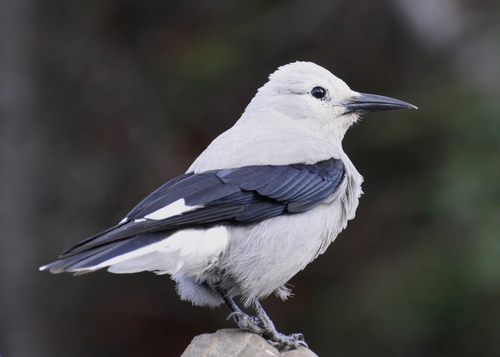
Clark's Nutcracker
Nucifraga columbiana
Meet the alpine architect of the West. Famous for its incredible memory, the Clark's Nutcracker is the genius of the high-country pines, caching thousands of seeds every year.
Quick Identification
Size
Length: 27-30 cm (10.6-11.8 in); Wingspan: 61 cm (24 in); Weight: 106-161 g (3.7-5.7 oz)
Colors
Pale ash-gray body with jet-black wings and central tail feathers; bold white patches on the wings and outer tail feathers; black bill and legs.
Key Features
- Ash-gray body with high-contrast black and white wings
- Long, pointed, heavy black bill
- Distinctive white outer tail feathers visible in flight
- Stout, jay-like posture with a short tail
When You’ll See Them
Geographic range
Where Does the Clark's Nutcracker Live?
The Clark's Nutcracker is a signature species of the rugged mountain ranges in western North America. Its native range spans from central British Columbia and southwest Alberta in Canada, stretching south through the Rocky Mountains and the Sierra Nevada into the southwestern United States and northern Mexico. While they are year-round residents of high-altitude forests, they are known to move to lower elevations or wander long distances during years when pine cone crops fail.
Basemap © OpenStreetMap contributors
Behavior
Clark’s Nutcrackers are highly intelligent members of the crow family, renowned for their incredible spatial memory. They are a keystone species in high-altitude ecosystems due to their symbiotic relationship with whitebark and limber pines. During the late summer and fall, a single bird can cache up to 30,000 pine seeds in thousands of different locations, remembering the vast majority of these spots up to nine months later to survive the winter and feed their young.
These birds are social but often appear bold and raucous, frequently traveling in loose groups. They use their specialized, sturdy bills to pry seeds out of pine cones and have a unique sublingual (under-the-tongue) pouch that allows them to carry dozens of seeds at once. While they are usually found in the remote high country, they can become quite habituated to humans in campgrounds and ski resorts, where they may scavenge for food scraps.
EverydayEarth exclusive
Camera Tips
To capture Clark’s Nutcrackers on your backyard or trail camera, focus on their primary motivator: pine nuts. If you live in a high-elevation area, placing a platform feeder or a flat rock station stocked with raw, unsalted pine seeds or large sunflower seeds will almost certainly attract them. Position your camera at a height of 4 to 6 feet, facing a natural landing spot like a weathered stump or a horizontal pine branch where the bird is likely to land before approaching the food.
These birds are very active and move with a forceful, jerky energy. Use a high shutter speed or high-frame-rate video setting to prevent motion blur when they are hammering at cones or seeds. Because they often cache food, you can capture fascinating behavior by providing a patch of soft, loose soil or pine duff within the camera's view; you may get footage of the nutcracker burying seeds for later retrieval.
During the winter, these birds are particularly attracted to suet and water sources in areas where liquid water is scarce. Setting up a heated birdbath can be a major draw for nutcrackers and other montane species. Ensure your camera is angled to catch the light from the side or behind the lens to properly illuminate their subtle gray plumage, which can otherwise look flat or washed out in the harsh alpine sun.
Similar Species
Species that look similar or are commonly confused with Clark's Nutcracker.
Frequently Asked Questions
Record Clark's Nutcracker at your habitat
Connect a camera to start building your own species record — AI identifies every visitor automatically.