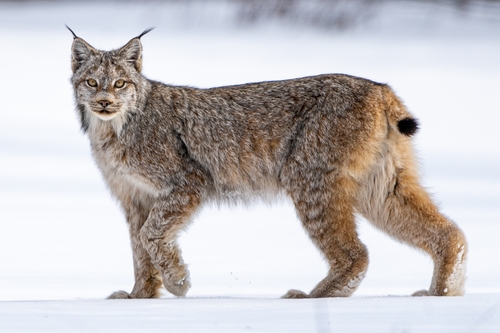
Canada Lynx
Lynx canadensis
A ghost of the northern woods, the Canada lynx is a master of the subarctic wilderness. Known for its oversized snowshoe paws and striking ear tufts, this elusive feline is the ultimate symbol of the boreal forest.
Quick Identification
Size
Length 75-105 cm (30-41 in); Height 48-56 cm (19-22 in); Weight 5-17 kg (11-37 lbs)
Colors
Silvery-grey to reddish-brown coat with faint spots; solid black tail tip; long black ear tufts
Key Features
- Long black triangular ear tufts
- Oversized paws with thick fur acting as snowshoes
- Short tail with a completely black tip
- Hind limbs significantly longer than forelimbs
When You’ll See Them
Geographic range
Where Does the Canada Lynx Live?
This cold-hardy feline is native to North America, spanning the vast northern stretches of the continent. Its core range covers nearly all of Canada and Alaska, extending south into the mountainous regions of the northern United States, including the Cascades, Rockies, and the North Woods of Maine and Minnesota. While they are occasionally sighted in lower latitudes during extreme food shortages, they are most at home in the deep snows of the subarctic.
Basemap © OpenStreetMap contributors
Behavior
The Canada lynx is a solitary and secretive ghost of the north, largely defined by its specialist relationship with the snowshoe hare. While they are primarily nocturnal, they are often active during the twilight hours of dawn and dusk, prowling through the dense undergrowth of the boreal forest with silent, padded steps. They are incredibly agile climbers and capable swimmers, though they spend most of their time hunting on the ground.
Despite their somewhat aloof nature, lynx are highly efficient hunters that use a 'sit and wait' strategy or active stalking. They are generally not aggressive toward humans and are rarely seen due to their exceptional camouflage and preference for remote, snowy landscapes. In years when hare populations decline, lynx may travel vast distances in search of new territory and food sources, sometimes appearing in areas far outside their typical range.
EverydayEarth exclusive
Camera Tips
Capturing a Canada lynx on camera requires targeting their specific travel corridors. Look for 'pinch points' in the forest—natural funnels between rock outcrops or dense thickets where a cat is likely to pass. Because they rely heavily on snowshoe hares, placing your camera near thick brush piles or areas with high hare activity is your best bet. Look for their distinctively large, circular tracks in the snow to confirm a corridor is active before setting up your gear.
Set your camera at a height of approximately 24 to 30 inches (60-75 cm). This allows for a clear view of their facial features and those iconic ear tufts. Unlike many other mammals, lynx are highly visual hunters and may be curious about movement. A small, shiny object or a single feather hung from a string nearby (where legal) can sometimes lure a lynx into staying in front of the lens longer, providing that perfect profile shot. Avoid traditional food baits, as these often attract non-target species like raccoons or bears.
Technical settings are crucial for these fast-moving cats. Use a high-quality trail camera with a trigger speed of 0.3 seconds or faster to avoid 'ghost' shots where only a tail is visible. Since they are most active in low light or total darkness, ensure your camera has a strong 'no-glow' or 'low-glow' infrared flash to avoid spooking the animal while providing clear night imagery. A wide-angle lens is preferable to capture the full body of the lynx, especially its long hind legs and broad paws.
Seasonal timing can also make a difference. Winter is arguably the best time for lynx photography, as the lack of foliage provides clearer sightlines and their massive paws are more prominent against the snow. During the mating season in March and April, lynx become slightly more vocal and active during the day, increasing your chances of a spectacular daylight capture. Always ensure your batteries are rated for sub-zero temperatures if you are monitoring them during the peak of winter.
Similar Species
Species that look similar or are commonly confused with Canada Lynx.
Bobcat
The bobcat has smaller paws, shorter ear tufts, and a tail that is white on the underside with black bands, whereas the lynx has a solid black tail tip.
Eurasian Lynx
The Eurasian lynx is significantly larger and often has more distinct spotting on its coat compared to the more uniform silvery-grey of the Canada lynx.
Frequently Asked Questions
Record Canada Lynx at your habitat
Connect a camera to start building your own species record — AI identifies every visitor automatically.