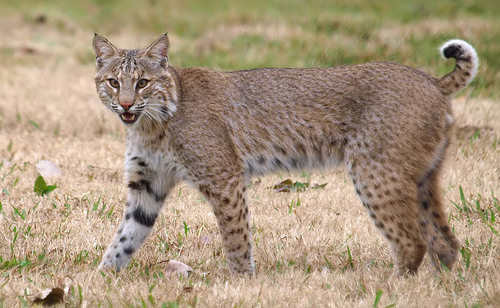
Bobcat
Lynx rufus
The bobcat is North America's most successful wild cat, a master of camouflage that can thrive everywhere from deep wilderness to quiet suburban backyards.
Quick Identification
Size
Length: 26–41 in (65–105 cm); Weight: 11–30 lbs (5–14 kg); Males are roughly 30% larger than females.
Colors
Buff to reddish-brown fur with dark spots and streaks; white underbelly; ears tipped with black tufts; tail has black bars on top and is white underneath.
Key Features
- Short 'bobbed' tail with white underside at the tip
- Distinctive facial ruffs resembling sideburns
- Pointed ears with small black tufts
- Longer hind legs than front legs, creating a slightly sloped profile
When You’ll See Them
Geographic range
Where Does the Bobcat Live?
Native to North America, the bobcat is the continent's most widely distributed wild feline. Its extensive range spans from southern Canada across nearly the entire contiguous United States and reaches as far south as central Mexico. Whether in the humid swamps of Florida, the arid deserts of Sonora, or the snowy woods of Maine, the bobcat has proven itself one of the most resilient predators in the Western Hemisphere.
Basemap © OpenStreetMap contributors
Behavior
Bobcats are the quintessential 'ghosts' of the North American wild, known for their incredible stealth and solitary nature. They are territorial animals, with males maintaining larger home ranges that often overlap with several females. While they are primarily crepuscular—focusing their hunting efforts around dawn and dusk—they are highly opportunistic and will adjust their schedule based on the activity of their prey or the presence of human interference.
In suburban environments, bobcats have become remarkably adept at navigating human-dominated landscapes. They often use greenbelts, drainage culverts, and backyard thickets as highways to move between hunting grounds. While they generally avoid direct human contact, they are not easily intimidated and may be seen lounging on a backyard fence or cooling off near a garden pond. Their social interactions are limited mostly to the breeding season, though mothers stay with their kittens for up to a year to teach them essential hunting skills.
EverydayEarth exclusive
Camera Tips
To capture high-quality footage of a bobcat, placement is everything. These cats are creatures of habit and prefer to travel along 'edges'—where a lawn meets a forest, along a fence line, or beside a stone wall. Position your camera about 12 to 18 inches off the ground, angled slightly upward. This 'knee-high' height is perfect for capturing the distinctive facial ruffs and the black-and-white tip of the tail, which are key for identification.
Because bobcats are highly visual hunters, you can often lure them into a camera's field of view using a 'visual attractor.' A simple feather or a piece of shiny tinsel suspended from a branch by a thin fishing line can pique their curiosity. As the object twists in the wind, the bobcat will likely pause to investigate, giving you the perfect still shot or video. Scent lures, such as commercial predator lures or even a small amount of catnip, can also encourage them to linger in front of the lens.
Settings-wise, bobcats move with a fluid, steady gait that can easily result in motion blur. Set your camera to a fast trigger speed (0.5 seconds or less) and use a 'burst mode' of 3-5 photos to ensure at least one clear frame. If your camera supports it, high-definition video is even better for observing their fascinating behavior. Since they are most active in low light, ensure your camera has a high-quality infrared flash (preferably 'no-glow' or 'black IR') so you don't spook the cat with a bright white light, which might prevent it from returning to that spot.
Similar Species
Species that look similar or are commonly confused with Bobcat.
Canada Lynx
The Lynx has much larger paws, longer ear tufts, and a tail tip that is solid black all the way around.
Mountain Lion
Mountain lions are much larger (75-150 lbs) and have an incredibly long tail that can reach three feet in length.
Domestic Tabby Cat
Domestic cats are smaller, have much longer tails relative to their body, and lack the distinctive facial ruffs and ear tufts of a bobcat.
Frequently Asked Questions
Record Bobcat at your habitat
Connect a camera to start building your own species record — AI identifies every visitor automatically.