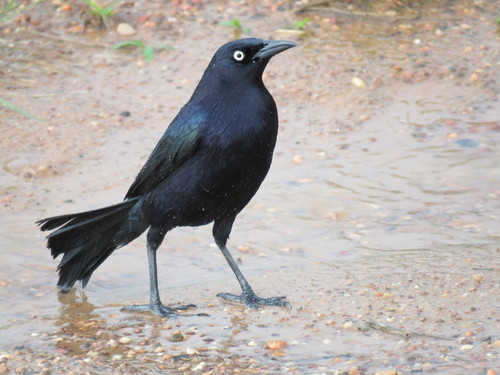
Carib Grackle
Quiscalus lugubris
The Carib Grackle is the charismatic, yellow-eyed socialite of the Caribbean. Bold, clever, and endlessly vocal, this glossy blackbird thrives wherever people and nature meet.
Quick Identification
Size
23–28 cm (9–11 inches) in length; wingspan of 34–40 cm (13–16 inches); weight 70–105 g (2.5–3.7 oz)
Colors
Males are glossy black with iridescent violet-blue highlights; females are dusky charcoal-brown with paler underparts. Both have striking pale yellow eyes.
Key Features
- Keeled V-shaped tail often held at a vertical angle
- Striking pale yellow iris contrasting with dark plumage
- Long, sturdy black bill with a slight downward curve
- Bold, upright posture when foraging on the ground
When You’ll See Them
Geographic range
Where Does the Carib Grackle Live?
Native to the tropical regions of northern South America and the Lesser Antilles, the Carib Grackle is a staple of the landscape from Colombia and Venezuela through the Guianas to northeastern Brazil. It is a widespread resident of islands across the Caribbean, including Trinidad and Grenada, and was successfully introduced to Tobago in 1905. Because it thrives in human-altered environments, its presence is often most concentrated in coastal lowlands and urban centers rather than deep, undisturbed forests.
Basemap © OpenStreetMap contributors
Behavior
The Carib Grackle is a highly social and intelligent bird, often found in noisy, gregarious flocks. They are famous for their fearlessness around humans, frequently seen patrolling outdoor cafes for crumbs or scavenging in backyard gardens. Their vocalizations are a complex series of harsh chirps, metallic whistles, and bell-like notes, often accompanied by a dramatic display where the male puffs out his feathers and spreads his tail.
These birds are cooperative breeders and often nest in small colonies, choosing tall trees or palms for protection. They exhibit remarkable problem-solving skills, such as dunking dry bread in water to soften it before eating. While they can be aggressive toward other birds during the nesting season, their bustling activity and constant chatter make them a lively presence in any tropical landscape.
EverydayEarth exclusive
Camera Tips
To capture the best footage of Carib Grackles, place your camera near a low-profile platform feeder or a flat stone where you can scatter seeds or small pieces of fruit. Because they are ground-foragers, a camera height of 12 to 24 inches off the ground is ideal for eye-level action shots. They are particularly attracted to water, so positioning a camera near a shallow birdbath will almost guarantee daily visits, especially during the heat of the afternoon.
These birds move with quick, jerky motions, so use a high shutter speed or a 'high-speed' video mode to avoid motion blur. If your AI camera supports it, set it to trigger on 'medium' sensitivity; they are large enough to be easily detected, but their frequent social interactions can lead to hundreds of short clips if the sensitivity is too high. Bright, indirect light is best for capturing the subtle violet iridescence in the male's feathers, which often looks plain black in harsh, direct midday sun.
Consider placing your camera near palm trees or tall garden shrubs during the spring nesting season. You might capture fascinating footage of them carrying nesting materials or engaging in their 'head-up' threat displays, where two birds face off with their bills pointed vertically toward the sky. Since they are permanent residents, you can maintain a consistent station year-round to observe their complex social hierarchies.
Similar Species
Species that look similar or are commonly confused with Carib Grackle.
Greater Antillean Grackle
Much larger with a heavier bill; found in the northern Caribbean islands like Cuba and Puerto Rico rather than the Lesser Antilles.
Shiny Cowbird
Smaller with a much shorter tail and dark eyes; lacks the V-shaped tail profile of the grackle.
Boat-tailed Grackle
Significantly larger with a much longer tail; restricted to the coastal United States.
Frequently Asked Questions
Record Carib Grackle at your habitat
Connect a camera to start building your own species record — AI identifies every visitor automatically.