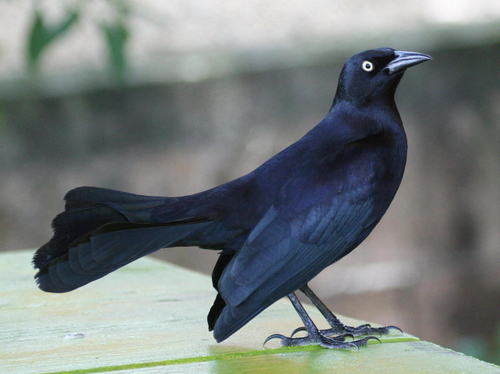
Greater Antillean Grackle
Quiscalus niger
The Greater Antillean Grackle is the bold, golden-eyed voice of the Caribbean. A master of adaptation, this glossy black bird brings charismatic energy and clever social behavior to every backyard it visits.
Quick Identification
Size
25-30 cm (10-12 in) in length; wingspan of 38-45 cm (15-18 in); weight 70-115 g (2.5-4 oz)
Colors
Males are glossy jet-black with a violet or blue-green iridescent sheen; females are similar but slightly smaller and occasionally more matte. Both sexes feature striking pale yellow to white eyes.
Key Features
- Long, V-shaped 'keeled' tail used for steering and display
- Piercing bright yellow or white iris
- Heavy, slightly curved black bill
- Iridescent black plumage with metallic highlights
When You’ll See Them
Geographic range
Where Does the Greater Antillean Grackle Live?
Native to the northern Caribbean, the Greater Antillean Grackle is a signature species of the Greater Antilles archipelago. Its core range spans across the islands of Cuba, Hispaniola (the Dominican Republic and Haiti), Jamaica, Puerto Rico, and the Cayman Islands. While it is a dedicated island resident, it thrives in nearly every terrestrial habitat these nations offer, from sea-level coastal plains to mid-elevation mountain valleys.
Basemap © OpenStreetMap contributors
Behavior
The Greater Antillean Grackle is an exceptionally social and vocal bird, often found in large, boisterous colonies. They are known for their 'displaying' behavior, where males puff out their feathers, spread their wings, and point their bills skyward while emitting a series of metallic whistles and clicks. They are highly intelligent and have adapted perfectly to human presence, often becoming quite tame in urban environments.
These birds are most active during the daylight hours, spending a significant amount of time foraging on the ground or in low vegetation. They are opportunistic problem-solvers, capable of opening food containers or working together to drive away larger predators. At night, they gather in massive communal roosts, often in thick trees or mangroves, where their collective chattering can be heard from blocks away.
EverydayEarth exclusive
Camera Tips
To capture the true beauty of the Greater Antillean Grackle, lighting is your most important tool. Their feathers are structurally colored, meaning they require direct sunlight to show off their violet and blue iridescence. Position your backyard camera facing North or South to avoid direct lens flare, but ensure the area where the birds land is bathed in morning or late afternoon sun. If the lighting is too flat, these birds will simply look like black silhouettes on your footage.
Because they are bold and frequently forage on the ground, place your camera at a low height—between 2 and 4 feet—mounted on a fence post or a specialized bird-cam tripod. They are very curious and will likely investigate the camera itself, so ensure your housing is secure. A wide-angle lens is preferred because these birds rarely travel alone; you’ll often find four or five individuals interacting, competing for food, or displaying to one another within the same frame.
Attracting them to your lens is simple with a platform feeder or a shallow water basin. They are particularly fond of cracked corn, sunflower seeds, and even soaked dog food or fruit scraps. If you use a motion-activated camera, set the sensitivity to high and use a short 're-trigger' interval. Greater Antillean Grackles move with quick, jerky motions and often fly off suddenly, so rapid-fire bursts or high-frame-rate video will give you the best chance of catching their unique tail-fanning displays.
Similar Species
Species that look similar or are commonly confused with Greater Antillean Grackle.
Boat-tailed Grackle
Found in the US; much larger with a significantly longer tail and different vocalizations.
Carib Grackle
Smaller in size and found primarily in the Lesser Antilles; lacks the specific 'squeaky hinge' call of the Greater Antillean.
Shiny Cowbird
Much smaller with a shorter, straight tail and dark eyes, unlike the yellow eyes of the grackle.
Frequently Asked Questions
Record Greater Antillean Grackle at your habitat
Connect a camera to start building your own species record — AI identifies every visitor automatically.