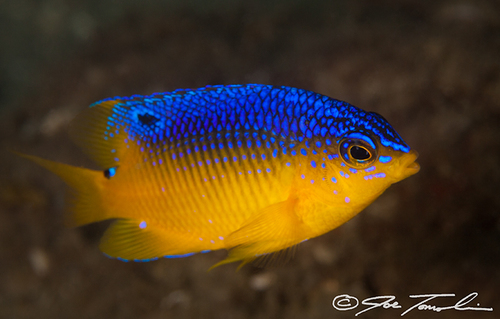
Caribbean Cocoa Damselfish
Stegastes xanthurus
The feisty 'gardener' of the Caribbean reefs, the Cocoa Damselfish is a small fish with a massive personality. Famous for its vibrant blue spots and fierce territorial defense, it is a fascinating study in underwater agriculture.
Quick Identification
Size
10-15 cm (4-6 inches) in length; typically weighs less than 100 grams (3.5 ounces)
Colors
Juveniles are bright yellow with blue spots and a dark spot on the tail; adults are dusky brown-grey with blue highlights on the head
Key Features
- Distinctive black spot on the upper base of the tail (peduncle)
- Electric blue spots on the head and back, especially in juveniles
- Oval, compressed body shape with a rounded tail
- Aggressive 'farming' behavior over algae patches
When You’ll See Them
Geographic range
Where Does the Caribbean Cocoa Damselfish Live?
Native to the Western Atlantic Ocean, the Caribbean Cocoa Damselfish is a quintessential resident of tropical reef systems. Its core range extends from the warm coastal waters of Florida and the Gulf of Mexico, through the entire Caribbean basin and the Bahamas, reaching as far south as the northern coasts of Brazil. These fish are strictly marine and are almost always found in shallow, clear waters where sunlight reaches the sea floor.
Basemap © OpenStreetMap contributors
Behavior
The Caribbean Cocoa Damselfish is a high-energy reef inhabitant known for its remarkable 'farming' behavior. These fish are intensely territorial, claiming specific patches of rocky reef or coral where they cultivate and protect filamentous algae. They act as underwater gardeners, weeding out undesirable organisms and aggressively defending their crop from much larger herbivores like parrotfish and surgeonfish.
Socially, they are predominantly solitary and do not school. Their interactions with humans are surprisingly bold; a Cocoa Damselfish will often swim right up to a snorkeler's mask or nip at a diver's fins to warn them away from its territory. They are strictly diurnal, spending their daylight hours patrolling their borders and retreating into small reef crevices at night to sleep and avoid predators.
EverydayEarth exclusive
Camera Tips
To capture the Caribbean Cocoa Damselfish on an underwater trail camera, you need to locate their 'garden.' Look for a patch of the reef that looks slightly 'fuzzier' or more overgrown with green or brown algae than the surrounding rocks; this is a damselfish territory. Place your camera on a weighted base or a small flexible tripod nearby, positioning the lens about 12 to 18 inches from the center of the algae patch for the best detail.
The territorial nature of this species is your best asset for photography. They are naturally curious and will likely swim directly toward the camera lens to investigate the 'intruder' in their space. You do not need bait, as the fish is tethered to its territory by its food source. Aim the camera horizontally or at a slight upward angle to capture the blue highlights of the fish against the sunlight filtering through the water.
Because the reef environment is high-glare, use a polarizing filter if your housing supports it. Set your camera to a fast shutter speed or high frame rate (at least 60fps) because these fish move in quick, jerky bursts. The best time for filming is between 10 AM and 2 PM, when the sun is directly overhead, providing the maximum light necessary to reveal the iridescent blue spots on juveniles and the intricate scale patterns of the adults.
Similar Species
Species that look similar or are commonly confused with Caribbean Cocoa Damselfish.
Beaugregory
The Beaugregory lacks the specific black spot on the upper tail base and often has a more vibrant blue-on-yellow contrast that lasts longer into adulthood.
Bicolor Damselfish
The Bicolor is sharply divided into a dark front half and a pale/white back half, unlike the more uniform brown or yellow of the Cocoa Damselfish.
Longfin Damselfish
Adults are much darker (almost black) and lack the distinct blue spots found on the head of the Cocoa Damselfish.
Frequently Asked Questions
Record Caribbean Cocoa Damselfish at your habitat
Connect a camera to start building your own species record — AI identifies every visitor automatically.