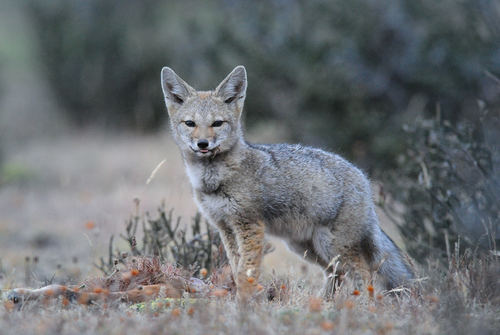
Chilla
Lycalopex grisea
The Chilla is a master of the Patagonian wilderness, a grizzled survivor that navigates everything from arid deserts to suburban fringes with cleverness and grace. Known for its 'salt-and-pepper' coat and curious eyes, this fox is a rewarding discovery for any backyard camera enthusiast.
Quick Identification
Size
Body length of 42–68 cm (17–27 in) and a weight of 2.5–5.4 kg (5.5–11.9 lbs)
Colors
Grizzled salt-and-pepper gray coat with a pale underbelly and yellowish-tan legs; features a prominent black tip on the tail.
Key Features
- Grizzled salt-and-pepper gray coat
- Distinctive dark spot on the chin
- Large ears and a bushy tail with a black tip
- Slender, dog-like build with tan-colored legs
When You’ll See Them
Geographic range
Where Does the Chilla Live?
The Chilla is native to the southern tip of the South American continent, occupying a vast range throughout Argentina and Chile. It is most commonly associated with the rugged landscapes of Patagonia, but its territory extends from the northern Atacama reaches down to the chilly archipelago of Tierra del Fuego. While they are core residents of the mainland, they have also been introduced to the Falkland Islands where they have established stable populations across various island habitats.
Basemap © OpenStreetMap contributors
Behavior
The Chilla, or South American gray fox, is a highly adaptable and inquisitive canid. While they are primarily solitary foragers, they typically maintain monogamous breeding pairs and share a home range. They are known for their opportunistic nature, often patrolling the same routes nightly to check for easy meals, whether that be a small rodent or leftovers from a human campsite.
These foxes are generally crepuscular, peaking in activity at dawn and dusk to avoid larger predators and human conflict. However, in protected areas where they feel secure, they can be surprisingly bold and may even be seen lounging in the sun during the day. They communicate through a variety of vocalizations, including sharp yaps and chattering sounds used during the breeding season or to defend territory.
EverydayEarth exclusive
Camera Tips
To capture the best footage of a Chilla, place your AI-powered camera at a low height, roughly 12 to 18 inches off the ground. This 'fox-eye view' ensures you capture the characteristic dark spot on their chin and the grizzled texture of their fur. Position the camera along 'edge' habitats, such as where a garden meets a field or along a fence line, as these foxes love to use man-made clearings for easy travel.
Since Chillas are highly motivated by scent, you can encourage them to pause in front of your lens using non-food lures. A small amount of sheep wool or even a cloth dabbed with a bit of vanilla extract can pique their curiosity without habituating them to human food. If you are in a particularly dry region, setting up your camera near a low-profile water basin is one of the most effective ways to guarantee a visit.
Lighting is key for this species, as their gray coat can blend into the shadows. Use a camera with high-quality infrared night vision to see their activity during the 'blue hour.' If your camera allows for sensitivity adjustments, set it to high; Chillas are light on their feet and can move quickly through the frame, so you want a fast trigger speed to avoid getting nothing but a blurry tail.
During the winter months (June to August), their coats are at their most thick and beautiful. This is also the breeding season, when they are much more vocal and active during the daylight hours. If you capture a Chilla on camera during this time, keep an eye out for a second one nearby, as they are often traveling with their mate during the late winter and early spring.
Similar Species
Species that look similar or are commonly confused with Chilla.
Frequently Asked Questions
Record Chilla at your habitat
Connect a camera to start building your own species record — AI identifies every visitor automatically.