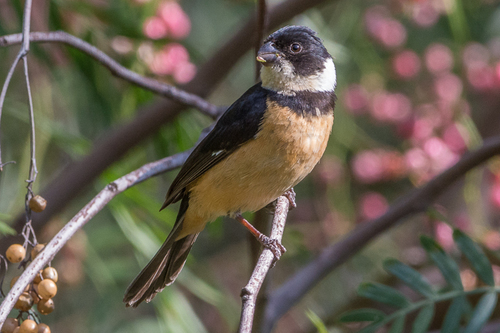
Cinnamon-rumped Seedeater
Sporophila torqueola
A dapper little songbird endemic to Western Mexico, the Cinnamon-rumped Seedeater is a master of the grasslands. Known for its rich, cinnamon tones and sweet, complex song, it is a delightful frequent visitor to suburban gardens and AI-powered backyard cameras.
Quick Identification
Size
Length: 10–11 cm (3.9–4.3 in); Wingspan: 15–17 cm (5.9–6.7 in); Weight: 8–11 g (0.28–0.39 oz)
Colors
Males have a black hood and 'collar,' cinnamon or buffy rump and belly, and black wings with white bars; females are olive-brown with buffy underparts and pale wing bars.
Key Features
- Stout, strongly curved black seed-cracking beak
- Distinctive black 'collar' pattern in males
- Warm cinnamon-colored rump and underparts in southern populations
- Small, energetic build often seen clinging to grass stalks
When You’ll See Them
Geographic range
Where Does the Cinnamon-rumped Seedeater Live?
This species is a native of the North American continent, specifically endemic to the Western Pacific slope of Mexico. Its core range extends from the northern state of Sinaloa southward through the coastal lowlands and interior valleys all the way to Oaxaca. While it is a resident species within this region, it may move locally depending on the availability of seeding grasses and water sources.
Basemap © OpenStreetMap contributors
Behavior
The Cinnamon-rumped Seedeater is a social and spirited passerine, frequently observed in pairs or small family groups. They are particularly famous for their acrobatic foraging style; they often cling to the stems of tall grasses, using their weight to bend the seed heads down so they can feed. Outside of the breeding season, they may form larger nomadic flocks, sometimes mixing with other finch and seedeater species to scour open fields for food.
During the breeding season, males are conspicuous and vocal, perching on high, exposed branches or fence wires to defend their territory with a sweet, warbling song. They are relatively comfortable around human habitation and are common sights in agricultural areas and suburban gardens, provided there is enough brushy cover and tall grass for nesting and foraging.
EverydayEarth exclusive
Camera Tips
To successfully capture the Cinnamon-rumped Seedeater on your backyard camera, focus on 'edge' habitats where manicured lawn meets taller, wilder vegetation. These birds feel safest when they can dart quickly from a grass stalk into a dense bush. Position your camera at a height of 2 to 4 feet, roughly chest-level for a human, and angle it toward a patch of seeding ornamental grasses or a specialized bird feeder. Since these birds are quite small, a close-focus lens or a camera positioned within 3-5 feet of the activity hub is ideal.
Baiting is highly effective for this species. They are particularly fond of white proso millet and niger seeds. Using a platform feeder or a ground-level tray will yield the best photos, as these birds are naturally comfortable feeding near the ground. If you have an AI-powered camera, ensure the sensitivity is set to high; their rapid, flitting movements can sometimes be missed by slower triggers. Early morning is the golden hour for this species, so place your camera facing north or south to avoid direct sun glare during these peak activity times.
Perhaps the most effective 'lure' for a Cinnamon-rumped Seedeater is a consistent water source. They are frequent bathers and drinkers, especially in the drier months. A shallow birdbath with a small solar dripper or fountain will create the sound of moving water, which acts as a beacon for them. Setting your camera to capture short video clips (10-15 seconds) rather than just stills will allow you to enjoy their charming tail-flicks and social interactions at the water's edge.
Similar Species
Species that look similar or are commonly confused with Cinnamon-rumped Seedeater.
Frequently Asked Questions
Record Cinnamon-rumped Seedeater at your habitat
Connect a camera to start building your own species record — AI identifies every visitor automatically.