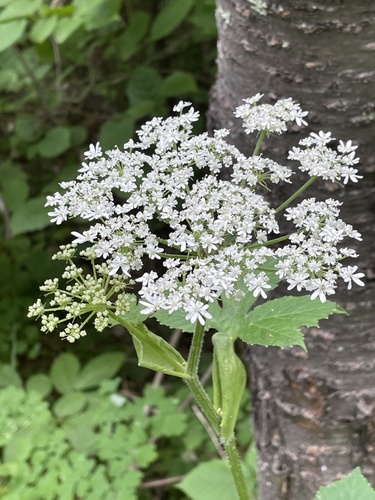
common cowparsnip
Heracleum maximum
Towering up to ten feet tall, the common cowparsnip is a native giant of the North American landscape, famous for its massive white flower umbrellas and its role as a pollinator paradise.
Quick Identification
Size
Stands 1 to 3 meters (3 to 10 feet) tall; flower umbels reach 10 to 20 cm (4 to 8 inches) in diameter.
Colors
Bright white flower clusters; stems are lime green to dark green, often with purple spotting; leaves are vibrant green with silvery-white undersides due to fine hairs.
Key Features
- Massive, deeply lobed leaves resembling giant maple leaves
- Flat-topped white flower clusters known as umbels
- Thick, hollow stems covered in distinct woolly white hairs
- Tall, robust stature often towering over surrounding vegetation
When You’ll See Them
Geographic range
Where Does the common cowparsnip Live?
Common cowparsnip is the only member of the Heracleum genus native to the North American continent. Its massive range spans from the Aleutian Islands of Alaska across the entirety of Canada to Newfoundland, and south through the United States into the mountains of Georgia, New Mexico, and California. It is particularly prolific in the moist, temperate regions of the Pacific Northwest and the cooler climates of the Rocky Mountains.
Basemap © OpenStreetMap contributors
Behavior
Common cowparsnip is a vigorous perennial plant that plays a vital role in the early to mid-summer ecosystem. Unlike many garden plants, it is a powerhouse of nectar production, attracting a dizzying array of pollinators including honeybees, native bumblebees, tachinid flies, and various butterflies. It follows a biennial or short-lived perennial life cycle, spending its first year as a low-growing rosette of leaves before sending up its massive flowering stalk in subsequent years.
While it is a cornerstone of biodiversity, cowparsnip has a defensive mechanism humans should respect. The plant contains furanocoumarins, chemical compounds in its sap that cause phytophotodermatitis. If the sap touches your skin and is then exposed to sunlight, it can cause significant blistering and discoloration. In the wild, it often grows in dense colonies, providing excellent cover for small mammals and nesting sites for birds in its lower foliage.
EverydayEarth exclusive
Camera Tips
Capturing the common cowparsnip on a trail camera offers a unique opportunity to document the 'micro-wildlife' of your backyard. Because the flower heads are stationary, they make excellent subjects for time-lapse photography. Set your camera to take a photo every 15-30 minutes during the peak blooming weeks in June or July to watch the massive umbels unfurl like slow-motion umbrellas.
To capture the insects that frequent the plant, mount your camera on a stake approximately 4 to 6 feet high, angled slightly downward toward the flat white flower heads. Using a camera with a high-speed trigger or a dedicated 'macro' mode is ideal, as the primary visitors—bees and butterflies—move quickly. Because the white flowers reflect a lot of light, you may need to adjust your exposure settings down to avoid 'blowing out' the highlights in bright midday sun.
Placement is key for capturing larger wildlife interactions. Deer and elk often browse the young, tender leaves of cowparsnip before they become too fibrous. Position your camera at knee-height (about 24 inches) facing a cluster of cowparsnip near a forest edge to catch these herbivores during their dawn and dusk feeding sessions. Look for 'browse lines' where the leaves have been neatly nipped off.
Safety is paramount when working with this species. When setting up or checking your camera, wear long sleeves and gloves to avoid contact with the sap. If you must clear some foliage to get a better shot, use garden shears rather than breaking stems by hand, as the hollow stems are full of the phototoxic sap. The best time to service cameras near cowparsnip is on overcast days or late in the evening when UV levels are low, reducing the risk of a skin reaction.
Similar Species
Species that look similar or are commonly confused with common cowparsnip.
Giant Hogweed
Much larger (up to 20 feet) with purple-spotted stems and stiff, bristly hairs rather than soft woolly ones.
Water Hemlock
Highly toxic; features bi-pinnate leaves and smaller, more separated flower clusters on hairless, purple-streaked stems.
Poison Hemlock
Features fern-like leaves and hairless stems with distinct purple spots, whereas cowparsnip has massive, broad leaves and fuzzy stems.
Frequently Asked Questions
Record common cowparsnip at your habitat
Connect a camera to start building your own species record — AI identifies every visitor automatically.