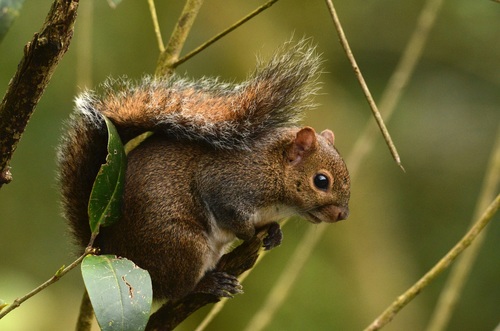
Deppe's Squirrel
Sciurus deppei
A small, agile resident of Central American forests, Deppe's Squirrel is easily recognized by its olive-brown coat and distinctive 'frosted' white-tipped tail.
Quick Identification
Size
Head-body 18–22 cm (7–8.7 in), tail 15–20 cm (5.9–7.9 in); weight 190–280g (6.7–9.9 oz)
Colors
Upperparts are olive-brown to reddish-brown with a grizzled appearance; underparts are white, buff, or pale orange; tail is dark with white-tipped hairs.
Key Features
- Olive-brown agouti fur on back
- White or buff-colored belly
- Tail hairs tipped with white, creating a 'frosted' look
- Relatively small and slender compared to other tropical tree squirrels
When You’ll See Them
Geographic range
Where Does the Deppe's Squirrel Live?
Native to the lush landscapes of Central America and Mexico, Deppe's Squirrel occupies a wide swathe of territory spanning from the eastern coasts of Mexico down to the verdant highlands of Costa Rica. This resilient rodent is a staple of the biodiversity in countries like Belize, Guatemala, El Salvador, Nicaragua, and Honduras, where it can be found in both lowland jungles and misty montane forests. While it thrives in undisturbed primary forests, it is also frequently encountered in rural gardens and shade-grown coffee plantations throughout its core range.
Basemap © OpenStreetMap contributors
Behavior
Deppe's Squirrel is a diurnal and highly active species, though it tends to be more secretive and quiet than its larger, noisier relatives. While it is an expert climber that spends much of its time in the canopy, it is frequently observed foraging on the forest floor, scurrying through leaf litter in search of fallen seeds and fruits. They are generally solitary animals, though multiple individuals may occasionally congregate near a particularly abundant food source, such as a fruiting palm tree.
In interactions with humans, they are typically shy and will quickly retreat to the high branches or the opposite side of a tree trunk when approached. However, in areas near agricultural land or shade-grown coffee plantations, they can become more habituated to human presence. Their vocalizations are high-pitched chirps, often used as alarm calls when a predator like a hawk or snake is detected nearby.
EverydayEarth exclusive
Camera Tips
To capture high-quality footage of Deppe's Squirrel, placement is everything. Unlike some squirrels that remain high in the canopy, these squirrels spend a significant amount of time foraging on the ground. Position your AI-powered camera 1 to 3 feet off the ground, aimed at the base of large trees or along fallen logs, which they often use as 'highways' to navigate the forest floor without rustling leaves.
Baiting can be highly effective for this species. A small pile of corn, sunflower seeds, or native palm fruits placed in a sunny patch of the forest floor will encourage them to linger long enough for a clear photo. If you are in a backyard setting, a platform feeder mounted on a tree trunk at chest height is an ideal focal point for your camera lens.
Because Deppe's Squirrels are fast and twitchy, set your camera to its fastest trigger speed (ideally under 0.5 seconds) and utilize a 'burst mode' or high-frame-rate video setting. They are most active during the early morning hours just after sunrise, so ensure your camera is positioned to avoid direct lens flare from the rising sun, which can wash out the details of their grizzled fur.
Seasonal considerations are minimal since they are active year-round, but you may see increased activity during the ripening of local fruit trees or corn harvests. During the rainy season, look for sheltered spots under dense foliage where the squirrels might stop to groom or feed out of the direct downpour.
Similar Species
Species that look similar or are commonly confused with Deppe's Squirrel.
Variegated Squirrel
Much larger than Deppe's Squirrel with highly variable and often more colorful fur patterns.
Red-bellied Squirrel
Typically has a much brighter, more distinct reddish-orange underside and is native to Asia (though introduced in some areas).
Richmond's Squirrel
Found in Nicaragua; it has more ochre-colored underparts compared to the lighter belly of Deppe's Squirrel.
Frequently Asked Questions
Record Deppe's Squirrel at your habitat
Connect a camera to start building your own species record — AI identifies every visitor automatically.