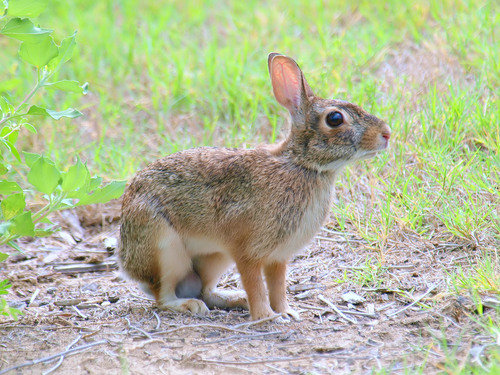
Eastern Cottontail
Sylvilagus floridanus
With its signature fluffy white tail and nervous twitch, the Eastern Cottontail is the quintessential backyard mammal. These masters of camouflage are frequent visitors to gardens and meadows, bringing a touch of woodland charm to suburban landscapes across the Americas.
Quick Identification
Size
14–19 inches (36–48 cm) in length; 1.8–3.3 lbs (0.8–1.5 kg) in weight
Colors
Brownish-gray upper body with black-tipped hairs; white belly and underside of tail; distinct rusty-red patch on the nape of the neck
Key Features
- Large, upright ears with black borders
- Distinctive fluffy white 'cotton ball' tail
- Rusty-red patch of fur on the back of the neck
- Large, dark eyes located on the sides of the head
When You’ll See Them
Geographic range
Where Does the Eastern Cottontail Live?
Native to the North American continent, the Eastern Cottontail boasts a massive range that stretches from the southern edge of Canada through the central and eastern United States. This hardy rabbit continues its southward journey through Mexico and Central America, reaching as far as the northern regions of South America. Because they thrive in human-altered environments, you can find them in nearly every temperate and subtropical habitat from the Atlantic coast to the Great Plains.
Basemap © OpenStreetMap contributors
Recorded on EverydayEarth
Behavior
The Eastern Cottontail is a master of the 'freeze and flee' strategy. When they sense a threat, they typically remain motionless, blending into the surrounding brush with their cryptic coloration. If a predator gets too close, they erupt into a high-speed, zigzagging sprint that can reach speeds of up to 18 miles per hour, often heading directly for the nearest dense cover.
While they are largely solitary animals, you may see several rabbits feeding together in areas with abundant food, such as a lush clover patch. They are highly territorial during the breeding season but generally avoid direct confrontation. In suburban environments, they have become remarkably bold, often grazing just feet away from human activity as long as they feel a clear path to safety is available.
EverydayEarth exclusive
Camera Tips
To capture the best footage of Eastern Cottontails, placement is everything. These rabbits are 'edge' specialists, meaning they rarely venture into the middle of a wide-open lawn. Position your camera along the transition zone where your lawn meets tall grass, shrubbery, or a woodpile. Aim the camera along a known 'run'—a faint path in the grass that they use repeatedly to travel between cover and feeding grounds.
Because Eastern Cottontails are short, your camera should be mounted very low to the ground, ideally between 6 to 12 inches high. A slight downward angle can help capture their facial expressions as they nibble on greens. If you are using a trail camera, set the PIR (Passive Infrared) sensitivity to 'High.' Rabbits can be surprisingly fast and twitchy; a high sensitivity setting ensures the camera triggers the moment their nose enters the frame.
For the best lighting, prioritize the 'Golden Hours.' Cottontails are crepuscular, meaning they are most active at dawn and dusk. If your camera has adjustable night settings, use a 'Fast Shutter' or 'Blur Reduction' mode to prevent the rabbit from appearing as a brown blur when it hops past. During winter, look for tracks in the snow leading to woody shrubs; placing a camera near a brush pile during a snowstorm often yields excellent footage of them foraging on bark.
While we don't recommend baiting with processed foods, planting a small patch of clover or leaving a fallen apple in front of the camera can act as a natural lure. Just be sure to keep the area clear of tall weeds directly in front of the lens, or the camera may trigger repeatedly on windy days, leaving you with thousands of photos of moving grass and no rabbits!
Similar Species
Species that look similar or are commonly confused with Eastern Cottontail.
Desert Cottontail
Found in more arid climates; has much larger, paler ears to help dissipate heat.
Marsh Rabbit
Smaller ears and a dingy gray/brown underside to the tail rather than bright white.
New England Cottontail
Nearly identical visually, but has a black spot between the ears and lacks the Eastern's white forehead spot.
Frequently Asked Questions
Record Eastern Cottontail at your habitat
Connect a camera to start building your own species record — AI identifies every visitor automatically.