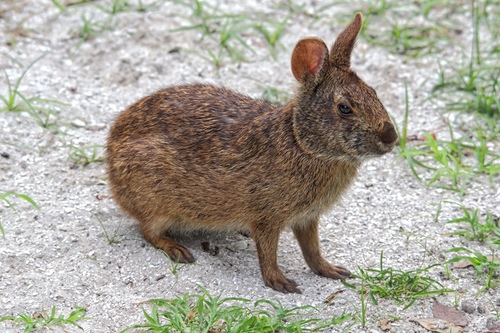
Marsh Rabbit
Sylvilagus palustris
The Marsh Rabbit is the Southeast's most elusive swimmer, a compact and hardy cottontail cousin that thrives in the densest swamps and coastal thickets.
Quick Identification
Size
Total length of 14-19 inches (35-48 cm); weight range of 2.2-3.5 lbs (1.0-1.6 kg)
Colors
Dull brownish-gray upperparts with a reddish-brown nape; underside is a dingy grayish-buff rather than pure white; tail is dark brown to gray on top and bottom
Key Features
- Significantly smaller ears and legs than the Eastern Cottontail
- Dingy grayish-brown belly (not white)
- Small, dark tail that lacks the white 'cotton' underside
- Unique 'walking' gait where limbs move alternately rather than hopping
When You’ll See Them
Geographic range
Where Does the Marsh Rabbit Live?
The Marsh Rabbit is an iconic resident of the coastal Southeast in North America. Its native range hugs the Atlantic and Gulf coasts, stretching from the wetlands of southeastern Virginia through the entire Florida peninsula—including the fragile ecosystems of the Lower Keys—and extending west into the marshy reaches of Alabama. This species is a true lowland specialist, rarely found far from the tidal marshes and freshwater swamps that define the region's humid landscape.
Basemap © OpenStreetMap contributors
Behavior
Unlike most of its cousins, the Marsh Rabbit is a semiaquatic specialist. It is an excellent swimmer and frequently takes to the water to escape predators or move between foraging grounds. When threatened, it often retreats into thick aquatic vegetation or submersed itself in water with only its nose and eyes exposed, a behavior similar to an alligator or hippopotamus.
Marsh Rabbits are predominantly nocturnal and crepuscular, though they can occasionally be seen during overcast days. They are generally solitary and highly territorial, maintaining strict home ranges within the dense cover of their wetland habitats. While they are capable of running fast in a zigzag pattern, they are more likely to 'walk' or crawl through thick brush than to hop like a typical field rabbit.
EverydayEarth exclusive
Camera Tips
To capture the Marsh Rabbit on camera, focus on 'edge' habitats where thick wetland vegetation meets a muddy bank or a narrow trail. Because these rabbits are low-slung and smaller than cottontails, mount your camera very low—roughly 6 to 10 inches off the ground. Angling the camera slightly upward can help capture identifying features like the chin and ear length, which are vital for distinguishing them from other species.
Since these rabbits are most active during the 'blue hour' of twilight and throughout the night, a camera with a high-quality Infrared (IR) flash is essential. Standard white flashes may startle them, but 'No-Glow' IR prevents spooking. Look for 'runs' or matted-down grass paths in the marsh; these are their highways. Placing a camera near a known exit point from a swamp into a foraging patch will yield the best results.
Marsh Rabbits have a unique gait; they often walk by moving their legs alternately rather than hopping. To capture this behavior, use a 'Video' setting or a high-speed 'Burst' mode (3-5 photos per trigger). This movement is a key diagnostic feature for AI identification. If you are in a backyard setting near a canal or marsh, avoid using traditional rabbit baits like carrots; instead, ensure there is a patch of native marsh grass or clover, which will naturally draw them into the frame.
Similar Species
Species that look similar or are commonly confused with Marsh Rabbit.
Frequently Asked Questions
Record Marsh Rabbit at your habitat
Connect a camera to start building your own species record — AI identifies every visitor automatically.