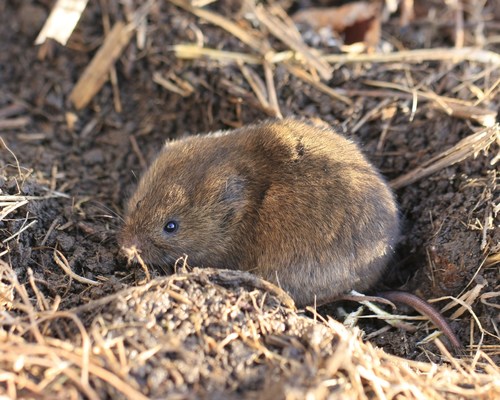
Eastern Meadow Vole
Microtus pennsylvanicus
The Eastern Meadow Vole is a master of the 'hidden highway,' building intricate tunnel networks beneath the grass. A vital part of the food chain, these busy rodents are active in every season, even under the winter snow.
Quick Identification
Size
Length: 12-19.5 cm (4.7-7.7 in); Weight: 28-70 g (1-2.5 oz)
Colors
Dull chestnut-brown to blackish-brown upper body; silvery-grey to buff underbelly; tail is bicolored (darker on top).
Key Features
- Small, rounded ears nearly hidden by dense fur
- Short tail, approximately 1/3 of total body length
- Stocky build with a blunt, rounded muzzle
- Beady black eyes and short legs
When You’ll See Them
Geographic range
Where Does the Eastern Meadow Vole Live?
Native to the North American continent, the Eastern Meadow Vole occupies a massive territory spanning from the subarctic regions of Alaska and Canada all the way to the Atlantic coast of the United States. This species is found as far south as Georgia and South Carolina, though it is most abundant in the northern and eastern regions of the US. Whether in a remote Canadian marsh or a lush suburban backyard in Ohio, this vole is a staple of the landscape across most of the northern half of the continent.
Basemap © OpenStreetMap contributors
Behavior
Eastern Meadow Voles are remarkably industrious rodents known for creating elaborate 'runway' systems through dense grass. These paths are created by the voles repeatedly traveling the same routes and clipping the vegetation down to the soil, creating a network of tunnels that provide cover from predators. They are active year-round and do not hibernate, often living in the 'subnivean zone' during winter—a space between the snow and the ground where they remain insulated from the cold.
Unlike many other small mammals, they are polyphasic, meaning they are active in short bursts during both the day and night. They are somewhat social but can be highly territorial during the breeding season. In suburban environments, they are often overlooked until the snow melts, revealing the maze of tracks they've left in the lawn. While they are a primary food source for hawks, owls, and foxes, their high reproductive rate allows their populations to thrive despite heavy predation.
EverydayEarth exclusive
Camera Tips
Capturing the Eastern Meadow Vole requires a unique approach because they rarely venture into the open. Look for their 'runways'—narrow, 1-2 inch wide paths in tall grass where the vegetation has been cleared to the dirt. Position your camera directly facing one of these intersections at a very low height, no more than 3-5 inches off the ground. A wide-angle lens or a camera with a short focal distance is ideal, as the action will happen very close to the sensor.
Because voles are small and fast, set your camera to its highest trigger speed and use a 'Burst' or 'Multi-shot' mode. They often zip across the frame in a fraction of a second. If your camera has a 'Macro' or 'Close-up' setting, ensure it is engaged. For nighttime shots, a high-quality no-glow infrared flash is essential to avoid startling the animal or washing out the image with too much light at close range.
To attract them to a specific spot, you can use a small amount of birdseed, oats, or apple slices placed directly in a known runway. During the winter, look for 'ventilation holes' in the snow. Placing a camera near these holes can capture them as they emerge for a brief moment. Be patient; while they are common, their preference for thick cover makes them a rewarding challenge for any backyard trail camera enthusiast.
Similar Species
Species that look similar or are commonly confused with Eastern Meadow Vole.
Frequently Asked Questions
Record Eastern Meadow Vole at your habitat
Connect a camera to start building your own species record — AI identifies every visitor automatically.