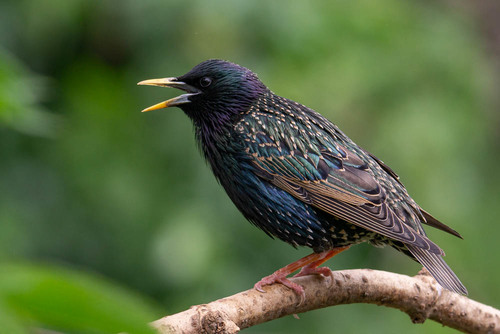
European Starling
Sturnus vulgaris
Master mimics with a 'starry' winter coat, European Starlings are the acrobats of the bird world. Whether performing massive aerial murmurations or imitating your neighbor's car alarm, these intelligent birds are a constant source of backyard drama.
Quick Identification
Size
Length: 19-23 cm (7.5-9 in); Wingspan: 31-44 cm (12-17 in); Weight: 55-100 g (2-3.5 oz)
Colors
Iridescent black with purple and green sheen; white-tipped feathers in winter; yellow bill (summer) or dark bill (winter); pinkish-red legs
Key Features
- Short, triangular wings and a pointed tail
- Yellow dagger-like bill during the breeding season
- Glossy iridescent plumage with white 'stars' or speckles
- Aggressive, fast-walking gait on the ground
When You’ll See Them
Sightings on EverydayEarth
Mar 17, 2026
A diverse group of birds congregates at the feeding station on a bright day. On the suet feeders to the left, a Red-bellied Woodpecker and a speckled European Starling take turns feeding. The main platform is crowded with Common Grackles and Red-winged Blackbirds. In the background, the partially frozen waters of the pond reflect the afternoon sun.
Feb 25, 2026
Two European Starlings are perched on a bird feeder tray filled with seeds and mealworms. They are actively foraging, pecking rapidly at the food, and occasionally adjusting their positions relative to each other. The surrounding backyard is covered in a thick layer of snow.
Aug 1, 2026
A speckled European Starling searches through the seed on the platform tray. Moments later, a male Red-winged Blackbird arrives, flashing its bright red shoulder patches as it moves from the center support to a hanging tube feeder.
Aug 1, 2026
A diverse group of birds is active at the feeder station during the early morning. A male Downy Woodpecker works on the log feeder while a male Red-winged Blackbird, showing its vibrant shoulder patches, feeds on the tray alongside several streaked females. A Common Grackle and a European Starling also compete for food in the center, while a male House Finch visits the tube feeder on the right. The birds are busy and constantly moving between the different food sources.
Jul 27, 2026
A Mourning Dove sits quietly on the right side of the tray feeder while three European Starlings forage actively for seeds around it. The starlings exhibit their typical busy feeding behavior, hopping and pecking through the mixed seed.
Jul 27, 2026
A vibrant morning at the feeders featuring a male Northern Cardinal feeding on the tray. A European Starling and a Downy Woodpecker share the suet feeder in the background. A Song Sparrow briefly joins the cardinal on the tray before the cardinal flies off, followed shortly by the other birds shifting positions.
Geographic range
Where Does the European Starling Live?
Originally native to Europe, North Africa, and Western Asia, the European Starling has become one of the most successful invasive species in history. It now maintains a massive footprint across North America, where the entire population grew from just a few dozen birds released in New York City in the 1890s. Beyond the Americas, established populations thrive in Australia, New Zealand, and South Africa, making it a truly global resident of temperate climates.
Basemap © OpenStreetMap contributors
Recorded on EverydayEarth
Behavior
The European Starling is one of the most social and intelligent birds you will encounter. They are famous for their 'murmurations'—massive, fluid flocks that move like a single organism across the evening sky to confuse predators. In your backyard, they are boisterous and vocal, often traveling in small groups and frequently outcompeting other birds at feeders with their assertive behavior.
These birds are master mimics, capable of imitating the songs of dozens of other bird species, as well as mechanical sounds like car alarms or whistles. They are highly adaptable and have successfully integrated into human-dominated landscapes, often nesting in the nooks and crannies of buildings or using abandoned woodpecker holes. While they are fascinating to watch, their large numbers in North America can sometimes be a challenge for native cavity-nesting species.
EverydayEarth exclusive
Camera Tips
To capture the stunning iridescence of a starling's plumage, position your AI-powered camera so the sun is behind the lens. The metallic greens and purples are most visible in direct morning or afternoon light. Because starlings are ground-foragers, a low-angle mount near a patch of short grass or a tray feeder can provide dramatic, eye-level footage of their unique 'open-bill probing' behavior.
If you want to attract them specifically to your camera, high-energy suet or mealworms are irresistible lures. However, be prepared—they often arrive in groups. Using a wide-angle lens setting is helpful if you want to capture the social dynamics of the flock. If your camera is near a birdbath, you are almost guaranteed great shots; starlings are enthusiastic bathers and will often splash vigorously, creating high-action video opportunities.
During the winter months, look for the 'speckled' look on your camera. This is when their feathers have white tips, making them look like a starry night sky. In the spring, watch for their bill color changing from dark to bright yellow. If your camera has a microphone, keep it active; you might catch them mimicking other backyard birds like hawks or killdeer, which they do with surprising accuracy.
Similar Species
Species that look similar or are commonly confused with European Starling.
Common Grackle
Grackles are larger with much longer tails and keep a dark bill year-round.
Brown-headed Cowbird
Cowbirds have a much shorter, thicker 'finch-like' bill and lack the starling's iridescence.
Red-winged Blackbird
Males are easily distinguished by their bright red and yellow shoulder patches, while females are heavily streaked like large sparrows.
Frequently Asked Questions
Record European Starling at your habitat
Connect a camera to start building your own species record — AI identifies every visitor automatically.