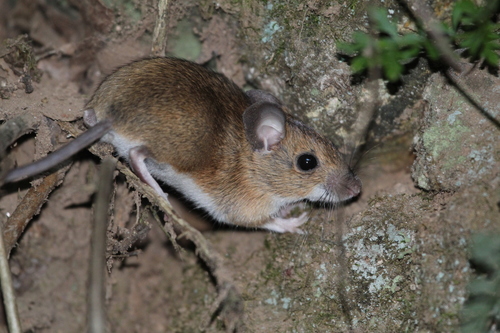
European Wood Mouse
Apodemus sylvaticus
With its oversized ears and soulful black eyes, the Wood Mouse is a master of the night. This agile jumper is one of the most common yet secretive visitors to European gardens.
Quick Identification
Size
Head-body 80–110 mm (3.1–4.3 in); Tail 70–115 mm (2.8–4.5 in); Weight 13–30 g (0.46–1.06 oz)
Colors
Sandy-brown to orangey-brown upperparts, distinct white or pale grey underparts, often with a small yellow smudge on the chest.
Key Features
- Large protruding black eyes
- Prominent translucent ears
- Long, powerful hind legs for jumping
- Tail roughly equal to the length of the head and body
When You’ll See Them
Geographic range
Where Does the European Wood Mouse Live?
The European Wood Mouse is native to the vast temperate regions of Europe and parts of North Africa. Its core territory extends from the British Isles and the Iberian Peninsula in the west, across the continent to Ukraine and the borders of Russia in the east. It is also found throughout the Mediterranean islands and southward into the Atlas Mountains of Morocco and Tunisia, thriving in almost any environment that provides sufficient cover and food.
Basemap © OpenStreetMap contributors
Behavior
The Wood Mouse is a highly energetic and agile rodent, known for its incredible leaping ability. When startled or moving quickly, it can hop like a miniature kangaroo using its powerful hind legs. Primarily nocturnal, it spends the daylight hours in extensive underground burrow systems or occasionally in bird boxes and attics, emerging at dusk to forage with remarkable speed and stealth.
Socially, Wood Mice are fascinatingly complex. While they are territorial during the peak breeding season, they often nest together in communal huddles during the winter months to conserve heat. They are also known for 'caching' behavior, where they collect and hide seeds or nuts in various locations to ensure a food supply during the colder months. Their interactions with humans are usually distant, though they are common visitors to suburban gardens and bird feeders.
EverydayEarth exclusive
Camera Tips
To capture high-quality footage of a Wood Mouse, place your camera as low as possible—ideally 10–15 cm from the ground. Since these mice are small, focus is critical; if your camera has a macro lens or a close-focus adjustment, set it to roughly 30–50 cm. Position the camera near a 'runway' like a garden wall, the edge of a fence, or a fallen log, as mice prefer to stay close to vertical structures for protection from owls.
Baiting is the most effective way to get a Wood Mouse to pause for the camera. Use a small handful of sunflower seeds or a smear of peanut butter on a rock or log. This encourages the mouse to stand still, allowing the AI to trigger and the camera to capture a sharp image. Because they are fast-moving, a camera with a fast trigger speed (under 0.3 seconds) is highly recommended to avoid getting only 'tail shots.'
Since Wood Mice are nocturnal, ensure your camera's infrared (IR) flash is optimized. 'No-Glow' IR is best to avoid startling the mouse, though 'Low-Glow' often provides slightly better image contrast for small subjects. If your camera supports video, record in 10-second clips; this captures their characteristic hopping and grooming behaviors, which are much more engaging than static photos. In autumn, look for areas with fallen acorns or hazelnuts, as these are natural magnets for Wood Mouse activity.
Similar Species
Species that look similar or are commonly confused with European Wood Mouse.
Frequently Asked Questions
Record European Wood Mouse at your habitat
Connect a camera to start building your own species record — AI identifies every visitor automatically.